
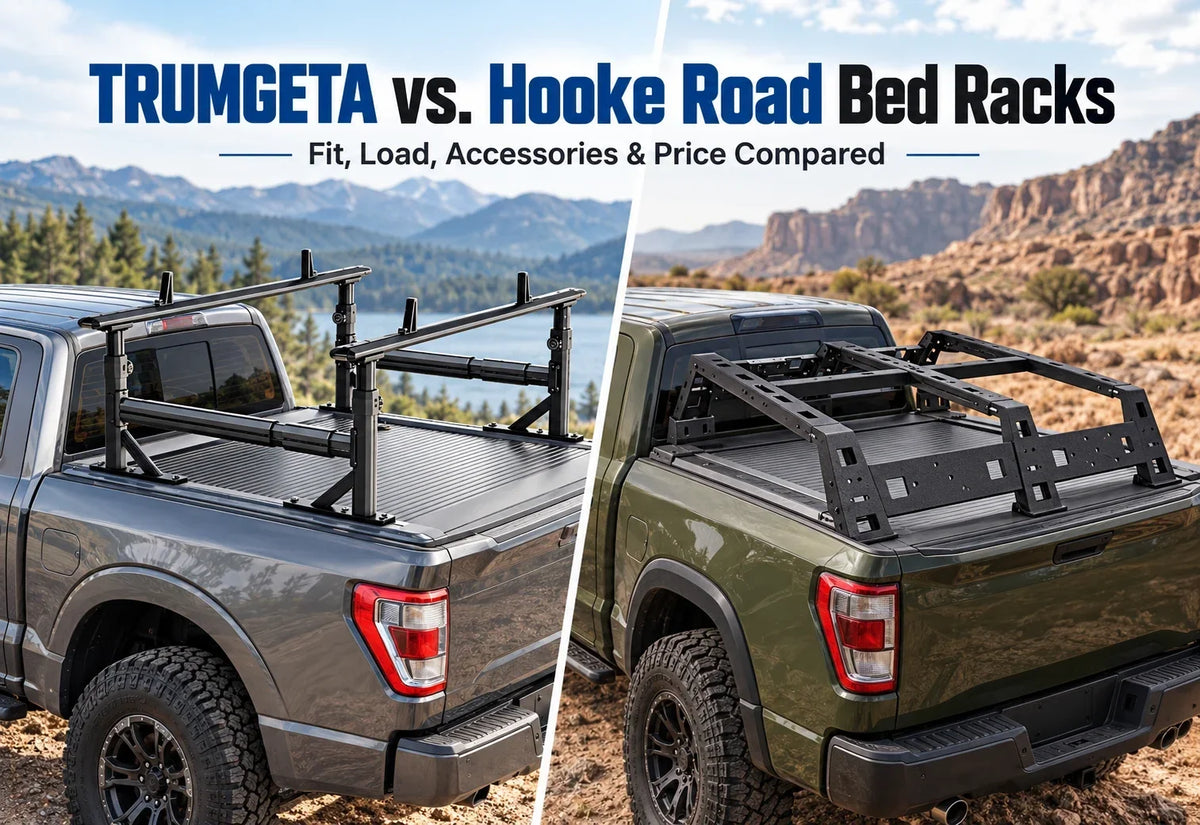
If you are comparing TRUMGETA vs. Hooke Road bed racks, the decision is not as simple as choosing the rack with the biggest load number or the lowest price. Both brands offer truck-bed cargo systems for work, camping, overlanding, rooftop tents, kayaks, recovery gear, and everyday hauling, but they approach the category differently.
Hooke Road currently offers several distinct rack styles, including fixed-height steel overland racks, vehicle-specific Tacoma racks, and low-profile aluminum crossbar systems. TRUMGETA's current lineup puts more emphasis on adjustable-height configurations, multiple fitment paths for mid-size and full-size pickups, universal T-slots, optional side bars, and dedicated options for trucks equipped with compatible T-slot tonneau covers.
That means the right choice depends on your truck, bed setup, load type, and how often you want to reconfigure the rack. This guide compares the two brands across the factors that matter most before you buy: fit, load ratings, rack height, accessory mounting, tonneau-cover compatibility, materials, installation, and price.
Quick answer: Hooke Road makes several straightforward fixed-height steel racks with integrated side-panel mounting space, while TRUMGETA offers a broader range of adjustable and T-slot-based rack configurations. If you already run a tonneau cover, rooftop tent, or mixed work-and-weekend setup, fitment and mounting architecture should matter more than a headline load number.
TRUMGETA vs. Hooke Road Bed Racks at a Glance
| Comparison Point | TRUMGETA | Hooke Road |
|---|---|---|
| Rack approach | Adjustable-height, low-profile, side-bar, T-slot and tonneau-compatible variants | Fixed-height steel overland racks plus selected aluminum crossbar systems |
| Height options | Several current models adjust roughly 19–25 in. across multiple positions | Common current examples include 11.5, 12.2 and 18.8 in. fixed-height designs |
| Materials | Aluminum alloy is common across current BASE/PRO/ULTRA lines; some steel options are also available | Many overland racks use powder-coated steel; selected low-profile racks use aluminum |
| Tonneau-cover options | Dedicated configurations for compatible T-slot retractable covers, plus separate no-cover/inner-rail applications | Many current Hooke Road overland racks explicitly exclude tonneau-cover setups |
| Accessory mounting | Universal T-slots, optional side bars and MOLLE-compatible mounting opportunities on selected setups | Slotted side panels and pre-cut mounting points are common on steel overland racks; T-slots appear on selected aluminum racks |
| Current price positioning | Broad collection ranging from entry-level rack systems to higher-capacity PRO/ULTRA configurations | Current examples range from lower-cost aluminum crossbars to more complete steel overland racks |
Product specifications, availability and prices change over time. Always confirm the exact SKU and your truck's bed configuration before ordering.
1. Fitment: Start With Your Truck Bed, Not the Brand Name
Fitment is the first place where a broad brand comparison can become misleading. Neither TRUMGETA nor Hooke Road sells one single rack that fits every pickup in every bed configuration.
Hooke Road's current lineup includes products designed around specific groups of trucks. For example, its 18.8-inch high overland rack is offered for combinations such as the 2005–2023 Toyota Tacoma 5-foot bed, Jeep Gladiator, and Ford Ranger, while other 12.2-inch and 18.8-inch racks target selected F-150, Ram 1500, Silverado and Sierra applications. Its Tacoma Max rack is specifically built around 2005–2023 Tacoma models and works with both short- and long-bed versions.
TRUMGETA takes a slightly different approach across much of its current bed-rack catalog. Several models are designed to cover groups of mid-size or full-size pickups by adjusting rack width and, on selected systems, rack height. The lineup includes applications for Tacoma, Gladiator, Ranger, Colorado, Frontier, F-150, RAM, Silverado, Sierra, Tundra and other popular pickups, depending on the specific SKU.
The important part is the bed mounting system. A truck with factory inner bed rails, a bare bed rail, and a retractable tonneau cover with T-slots may require three different mounting solutions even if the make and model are identical.
What to check before ordering either rack
- Truck make, model and model year
- Bed length
- Factory bed rail or utility-track system
- Whether a tonneau cover is installed
- Whether the tonneau cover has usable T-slot channels
- Distance between the bed rails
- Desired rack height relative to the cab roof
If you are shopping TRUMGETA, the Truck Bed Rack Finder is a useful starting point because it separates rack recommendations by truck size, cover setup, side-bar preference, and intended use.
2. Tonneau-Cover Compatibility Is One of the Biggest Differences
For many truck owners, this is more important than load capacity.
A bed rack and tonneau cover compete for the same real estate around the bed rails. If both products need the same mounting surface, they may not work together even when each product fits the truck individually.
Many of Hooke Road's current fixed-height overland racks explicitly state that they are not compatible with tonneau covers. That includes representative 12.2-inch and 18.8-inch steel systems for several Tacoma, F-150, Ram, Silverado, Sierra, Ranger, Colorado and Canyon applications.
That is not necessarily a disadvantage if you run an open bed. A simple bed-rail mounting system can be exactly what a truck owner wants for an overland rack that stays installed full time.
TRUMGETA, however, has developed multiple rack variants specifically around trucks equipped with compatible T-slot retractable tonneau covers. On these configurations, the rack mounts through the cover's usable top channels instead of requiring the same exposed bed-rail surface.
That makes this type of setup useful for owners who want to keep camping gear, tools or luggage covered below while carrying a tent, kayak, ladder, bike or cargo system above.
Important: “Tonneau compatible” does not mean compatible with every tonneau cover. TRUMGETA's cover-compatible racks are intended for specific T-slot-style configurations. Measure the available channel and rail clearance before ordering.
Explore current options in the TRUMGETA Truck Bed Rack Collection.
3. Height: Fixed Simplicity vs. Adjustable Setup
Rack height affects more than appearance. It changes aerodynamics, roof clearance, tent position, cargo access, and how easily long items can extend over the cab.
Hooke Road currently offers multiple fixed-height rack formats. Common examples include approximately 11.5-inch, 12.2-inch and 18.8-inch systems. That makes the buying decision fairly straightforward: choose the rack architecture and height that fits the job.
A lower rack can keep cargo closer to the bed and may make gear easier to reach. A taller rack creates more room below the crossbars and can make it easier to carry long cargo at or near cab-roof height.
Several current TRUMGETA adjustable racks take a different approach. Selected BASE and PRO configurations provide approximately 19–25 inches of height adjustment across multiple positions. That gives owners more freedom to change the rack around different loads.
For example, you might run the rack lower for a rooftop tent to keep the center of gravity and overall profile down, then raise it when carrying ladders or lumber that need more cab clearance.
Adjustable height is most useful when:
- You use the same truck for work during the week and camping on weekends
- You switch between a rooftop tent and long cargo
- You want to fine-tune the rack relative to cab-roof height
- You change accessories frequently
A fixed-height rack can still be the cleaner choice if you already know exactly how the truck will be configured and do not expect the setup to change.
4. Load Ratings: Do Not Compare the Biggest Number on the Page
Load capacity is one of the easiest bed-rack specifications to misunderstand.
Manufacturers may publish static, on-road dynamic, and off-road dynamic ratings. Those numbers describe different conditions and should never be treated as interchangeable.
Static load
Static capacity applies when the vehicle is parked. This is especially relevant to rooftop-tent setups because the rack must support the tent and occupants while the truck is stationary.
Dynamic load
Dynamic capacity applies while the vehicle is moving. Acceleration, braking, cornering and bumps place additional forces on the rack and mounting points.
Off-road load
Off-road travel can create sharper shock loads than normal pavement, so some manufacturers publish a separate lower off-road rating.
Representative Hooke Road steel overland racks currently list ratings around 400 lb dynamic / 800 lb static, while its Tacoma Max 11.5-inch rack lists approximately 440 lb dynamic / 880 lb static. Its low-profile aluminum crossbar rack uses a different architecture and lists lower on-road and off-road capacities.
TRUMGETA's range also varies by model. Its current rack comparison page lists different static and dynamic capacities across daily-utility, heavy-work, camping and light-trail configurations, while higher-capacity ULTRA models carry different published ratings again.
The useful takeaway is not that one brand has one universal load number. It is that you should compare the exact rack you are considering under the same load condition.
Before mounting a rooftop tent, ask:
- What is the rack's static load rating?
- What is its dynamic load rating?
- Is there a separate off-road limit?
- Does the stated rating assume evenly distributed weight?
- What is the vehicle manufacturer's bed and payload limit?
- How much do the rack, tent and mounted accessories weigh together?
The rack rating does not override your truck's own payload limitations.
5. Materials: Steel vs. Aluminum Changes the Character of the Rack
Hooke Road's best-known overland racks in this comparison are largely built from powder-coated steel. The company uses different steel gauges depending on the component and model, with reinforced mounting structures and textured black finishes.
Steel can make sense for an owner who wants a substantial, traditional overland rack with large side panels and a planted feel. The tradeoff is weight: some current Hooke Road full-height racks weigh well over 100 pounds before gear is added.
TRUMGETA uses aluminum alloy across many current adjustable bed racks. Aluminum reduces rack mass and naturally avoids red rust in the way exposed carbon steel can, while powder coating adds another exterior barrier and a uniform black finish.
Material alone does not determine durability. Joint design, brackets, fasteners, wall thickness, crossbar geometry, coating preparation and load distribution all matter.
For shoppers, the practical distinction is often:
- Steel: substantial construction and traditional overland-rack architecture, usually with more rack weight.
- Aluminum: lower system weight and strong corrosion resistance, useful when the truck already carries a tent and multiple accessories.
6. Accessory Mounting: Side Panels vs. T-Slot Modularity
Both brands understand that a bed rack is rarely purchased just to carry one object.
Hooke Road's steel overland racks typically use slotted side panels or pre-cut mounting holes. Those panels create places for equipment such as traction boards, fuel or water containers, Hi-Lift-style jacks, fire extinguishers, lights and other trail gear.
That architecture is intuitive: the side panel itself becomes the accessory wall.
TRUMGETA leans heavily on T-slot channels across selected crossbars and modular structures. T-slots let users slide compatible hardware into different positions for rooftop tents, cargo boxes, work lights, tools, awnings and other mounts. Optional side bars on selected PRO racks add more lateral attachment locations.
The difference is less about “more accessories” and more about how you prefer to mount them.
A side-panel system is useful when:
- You want large visible mounting zones on both sides of the bed
- Your build revolves around recovery gear and overland accessories
- You prefer fixed panel locations with many holes or slots
A T-slot system is useful when:
- You frequently reposition accessories
- You mount crossbar-based gear such as tents, cargo boxes or bike/kayak mounts
- You want a cleaner rack when side panels are not needed
- You plan to add or remove side bars as the build changes
7. Installation: Both Brands Offer Bolt-On Options, but Assembly Differs
Most truck owners shopping this category want to avoid drilling into the bed.
Representative Hooke Road overland racks use fully bolt-on installation and are shipped disassembled. Current product pages commonly estimate roughly 1.5–2 hours for assembly and installation on compatible trucks, depending on the rack.
Selected TRUMGETA adjustable racks also use no-drill mounting and list installation within roughly two hours. Some current models ship pre-assembled to reduce the amount of rack structure that must be built before mounting.
Installation difficulty still depends on the truck and rack. A large steel rack weighing more than 100 pounds may be easier with a second person even when the bolt pattern itself is simple.
8. Price: Compare the Complete Setup, Not Just the Base Rack
Both brands cover more than one price point.
As of September 2026, representative Hooke Road bed-rack listings include a low-profile aluminum crossbar rack around the low-$200 range, 12.2-inch steel overland racks around the low-$300 range, and several more complete Tacoma or full-height overland racks around roughly $400–$440 before any optional accessories or future price changes.
TRUMGETA's current Truck Bed Rack collection also spans multiple price levels, from simpler rack configurations in the low hundreds to side-bar, tonneau-compatible and higher-capacity PRO/ULTRA systems at higher price points.
Instead of asking which rack has the lowest advertised price, calculate the setup you actually want:
- Base rack
- Tonneau compatibility hardware
- Side bars or panels
- Rooftop-tent mounting hardware
- Accessory brackets
- Shipping, if applicable
- Any future hardware required to change the setup
A cheaper rack is not cheaper if it forces you to replace a tonneau cover or buy another rack later when your build changes.
9. Which Rack Style Fits Different Truck Owners?
For a straightforward fixed overland build
A vehicle-specific Hooke Road steel rack can make sense when you want a defined fixed height, integrated side-panel storage, and do not need to preserve a tonneau-cover setup.
For a truck that changes between work and weekend use
An adjustable TRUMGETA rack can be useful when you want to change height, add or remove side bars, or reposition T-slot-mounted accessories around different jobs.
For a rooftop tent plus covered bed
Look closely at TRUMGETA's dedicated T-slot tonneau-compatible configurations if your retractable cover has the correct channels. Verify the exact cover before ordering.
For an open-bed Tacoma overland build
Both brands offer relevant options. Hooke Road has vehicle-specific Tacoma racks at different fixed heights, while TRUMGETA offers Tacoma-compatible BASE, PRO and other adjustable systems depending on rail and cover configuration.
For kayaks, ladders and long cargo
Crossbar width, cab clearance and rack height matter as much as side-panel storage. An adjustable rack can help align long cargo around the cab roof, while a fixed rack provides a known geometry that does not need to be reset.
10. TRUMGETA vs. Hooke Road: What Matters Most Before You Buy?
The most meaningful difference between these two product ranges is configuration philosophy.
Hooke Road's current steel overland racks often give you a complete, recognizable fixed-height structure with large side mounting panels. You choose the rack that matches your vehicle and preferred height, bolt it together, and build your gear system around it.
TRUMGETA's current lineup gives shoppers more ways to configure the rack around the bed setup. Adjustable height, T-slots, optional side bars, separate inner-rail mounting versions, and dedicated T-slot tonneau-cover variants make the lineup especially relevant to owners who expect their setup to evolve.
Neither approach removes the need to confirm fitment.
Before buying any bed rack, prioritize these questions:
- Does it fit my exact truck, bed length and rail system?
- Will it work with my current or planned tonneau cover?
- Is the height right for my rooftop tent, long cargo or garage?
- Is the relevant dynamic/static rating sufficient for my real load?
- Can I mount the accessories I actually use?
- Will I want to change the rack configuration later?
Answer those six questions and the brand decision becomes much easier.
Explore TRUMGETA Truck Bed Rack Options
TRUMGETA offers bed-rack configurations for daily utility, work hauling, camping, overlanding, rooftop tents, and trucks equipped with compatible T-slot tonneau covers.
Frequently Asked Questions
Are TRUMGETA bed racks compatible with tonneau covers?
Selected TRUMGETA bed racks are designed for pickups with compatible T-slot retractable tonneau covers. Other TRUMGETA racks are intended for factory inner-rail or no-cover setups. Check the specific product rather than assuming every rack works with every cover.
Are Hooke Road bed racks compatible with tonneau covers?
Many of Hooke Road's current fixed-height overland bed racks explicitly state that they are not compatible with tonneau covers. Compatibility varies by product, so verify the exact rack page and bed mounting system before ordering.
Which brand offers adjustable-height bed racks?
Several current TRUMGETA models offer multi-position height adjustment, commonly around 19–25 inches on selected systems. Many representative Hooke Road overland racks use fixed heights such as 11.5, 12.2 or 18.8 inches.
Can a TRUMGETA or Hooke Road bed rack support a rooftop tent?
Both brands offer racks with published load ratings that can support many rooftop-tent setups, but you must compare the tent's weight with the exact rack's static and dynamic ratings and your truck's payload limits. Do not rely on the largest rating from another model in the same brand.
What is the difference between static and dynamic bed-rack capacity?
Static capacity applies while the truck is parked. Dynamic capacity applies while the truck is moving. Off-road use can create additional shock loads, so use a separate off-road rating when the manufacturer provides one.
Are aluminum bed racks better than steel bed racks?
Neither material is automatically better. Aluminum usually reduces rack weight and offers strong corrosion resistance, while steel can provide a substantial traditional overland-rack structure. Overall design, mounting hardware, load distribution and finish are also important.
Which bed rack is better for a Toyota Tacoma?
That depends on Tacoma generation, bed length, factory rail system, tonneau cover and intended use. Hooke Road offers several Tacoma-specific fixed-height racks, while TRUMGETA offers multiple Tacoma-compatible configurations including adjustable and T-slot tonneau-compatible options.
Do I need side panels or side bars on a truck bed rack?
Not necessarily. Side panels or bars are useful for mounting recovery equipment, tools, lights and accessories. If you mostly carry cargo on the crossbars, a cleaner rack without side hardware may be sufficient.
How should I compare bed-rack prices?
Compare the cost of the complete setup you need, including tonneau compatibility, side bars or panels, accessory mounts and rooftop-tent hardware. The lowest base price may not be the lowest total build cost.
Editorial note: Product specifications and publicly listed prices referenced in this comparison were checked in September 2026 and may change. Always verify current manufacturer fitment, ratings, availability and installation requirements before purchasing.

Leave a comment
This site is protected by hCaptcha and the hCaptcha Privacy Policy and Terms of Service apply.