
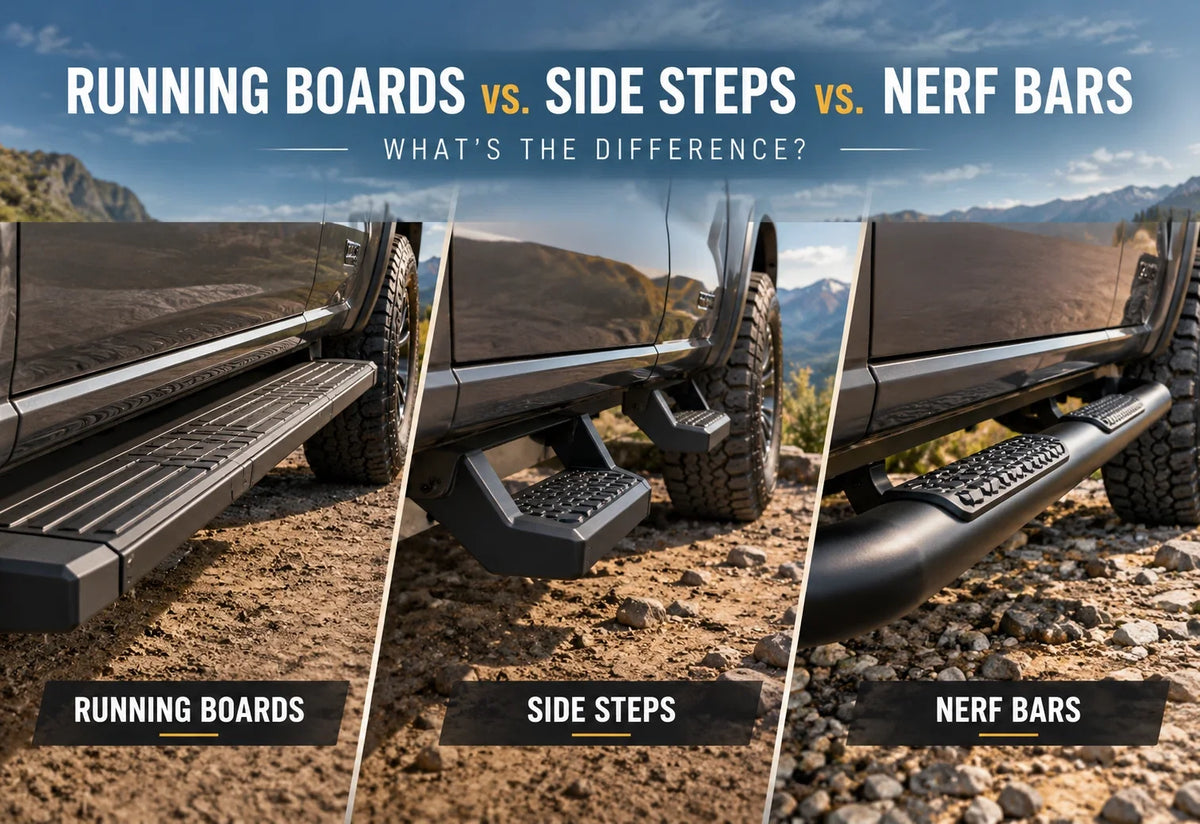
Running Boards vs. Side Steps vs. Nerf Bars: What’s the Difference?
If you are shopping for a better way to get in and out of your truck, you have probably run into three terms over and over again: running boards, side steps, and nerf bars.
They all serve a similar basic purpose—giving you a secure step between the ground and the cab—but they are not always the same thing.
The biggest differences come down to step size, design, ground clearance, entry height, and how you actually use your truck.
For a daily-driven pickup carrying kids or passengers, a wide running board may make the most sense. A compact side step can be a better fit if you want to preserve ground clearance. A nerf bar falls somewhere in between, combining a tubular profile with designated stepping areas.
Here is how to tell them apart.
Quick Answer: Running Boards vs. Side Steps vs. Nerf Bars
Running boards usually have a wide, flat stepping surface that extends along most or all of the cab.
Side steps can refer broadly to almost any step mounted along the side of a truck, but the term is also commonly used for smaller individual steps positioned below specific doors.
Nerf bars are typically round, oval, or rectangular tubular bars with smaller designated step pads rather than one continuous platform.
The right choice depends less on the product name and more on where the step sits, how large the stepping surface is, and how much clearance you want to keep underneath the truck.
| Feature | Running Boards | Side Steps | Nerf Bars |
|---|---|---|---|
| Typical Design | Wide, flat board | Compact individual step | Tubular bar |
| Step Coverage | Most or all of cab | Specific entry points | Individual step pads |
| Footing Area | Large | Small to medium | Medium |
| Ground Clearance | Varies by design | Often easier to preserve | Usually moderate |
| Daily Passenger Use | Excellent | Good | Good |
| Lifted Truck Access | Good with drop design | Depends on position | Depends on mounting height |
| Visual Style | Clean / factory-style | Minimal / rugged | Sporty / traditional truck |
| Best For | Families and daily driving | Clearance-conscious builds | Owners wanting tubular styling |
One important note: aftermarket terminology is not standardized. Some manufacturers use “side steps” as a general category that includes running boards, nerf bars, drop steps, and other truck steps.
That is why you should always look at the actual design rather than shopping by name alone.
What Are Running Boards?
Running boards are usually the easiest type to recognize.
A traditional truck running board features a wide, relatively flat platform running underneath the doors, giving the driver and passengers a large surface to step on.
Instead of trying to place your boot on one specific pad, you can generally step almost anywhere along the board.
Why Truck Owners Choose Running Boards
The larger stepping area makes running boards especially practical for:
-
Daily-driven pickups
-
Families with children
-
Older passengers
-
Dogs entering or exiting the cab
-
Trucks with higher factory ride heights
-
Owners who frequently access roof-mounted cargo
-
Work trucks where drivers enter and exit repeatedly
A wider board also gives you more room when your boots are muddy, wet, or covered in snow.
For that reason, running boards are often less about aggressive truck styling and more about everyday accessibility and predictable footing.
What Do Running Boards Look Like?
Traditional running boards tend to sit relatively close to the rocker panel and extend across the cab.
Common designs include:
-
5-inch running boards
-
6-inch running boards
-
Flat aluminum boards
-
Steel running boards
-
Low-profile running boards
-
Drop-down running boards
-
Power-retractable running boards
The shape can vary dramatically, but the defining feature is usually the larger, more continuous stepping surface.
What Are Side Steps?
“Side step” is the most confusing term of the three.
In some catalogs, side steps simply means the entire category of products mounted along the side of a vehicle to help passengers enter the cab.
Under that definition, running boards and nerf bars are both types of side steps.
However, when truck owners specifically compare side steps vs. running boards, “side step” often refers to a smaller independent step located underneath one door or entry point.
Instead of installing one long board along the entire cab, individual steps are mounted only where they are needed.
Why Choose Compact Side Steps?
Compact truck side steps can make sense when you want:
-
Less hardware along the side of the truck
-
A more minimal appearance
-
Easier entry without a full-length board
-
Less weight than some full-length systems
-
More open space beneath the rocker area
-
Better ground clearance for uneven terrain
-
Steps positioned exactly where you want them
This type of setup is particularly useful for truck owners who want easier cab access but do not necessarily want a large running board hanging underneath both doors.
TRUMGETA's compact Auxchemic® Side Steps, for example, use independent step modules rather than a traditional full-length platform, giving Tacoma and other truck owners another option between a large running board and having no step at all.
What Are Nerf Bars?
Nerf bars are traditionally built around a round or oval tubular bar mounted underneath the doors.
Instead of offering a continuous flat surface, they usually include specific traction pads positioned where the driver and passengers are expected to step.
Classic nerf bars commonly use:
-
Round tubing
-
Oval tubing
-
Steel construction
-
Black or polished finishes
-
Individual rubber or textured step pads
The tubular construction gives them a more traditional aftermarket truck appearance.
Why Choose Nerf Bars?
Nerf bars are often attractive to drivers who want:
-
Easier cab access
-
Less visual mass than a wide running board
-
A classic pickup-truck appearance
-
Defined stepping points
-
A relatively simple bolt-on upgrade
However, a narrow tubular step usually provides less usable foot space than a wide running board.
That difference becomes more noticeable when passengers are wearing work boots, winter footwear, or muddy trail shoes.
Running Boards vs. Nerf Bars: What Is the Main Difference?
The biggest difference between running boards and nerf bars is the stepping surface.
A running board generally gives you a wide platform across much of the cab.
A nerf bar generally gives you a tubular structure with smaller dedicated step pads.
That difference affects comfort, appearance, and how easy the step is to use every day.
Choose Running Boards If You Want:
-
More room for your entire foot
-
Easier entry for kids or passengers
-
A more integrated appearance
-
A stable everyday stepping platform
-
Multiple places to stand along the cab
Choose Nerf Bars If You Want:
-
A tubular truck-accessory look
-
Smaller designated stepping areas
-
Less visual bulk
-
A more traditional aftermarket style
Neither design is automatically better. It depends on what matters more for your truck.
Side Steps vs. Running Boards: Which Gives Better Ground Clearance?
This depends heavily on the design.
A compact side step can often preserve more open space underneath the rocker area because there is no continuous board running between the wheel wells.
But you also need to consider how far the step hangs downward.
A compact step mounted close to the cab may retain excellent clearance.
A deep drop step mounted several inches lower may make entry easier but become more likely to contact rocks, deep ruts, curbs, or other obstacles.
The same rule applies to running boards.
A narrow, body-hugging running board can stay relatively high and tight, while a drop-down running board intentionally positions the step lower.
For anyone who regularly drives trails, construction sites, ranch roads, or uneven terrain, do not judge clearance from the product category alone.
Look at:
-
The bottom of the installed step
-
How far it extends outward
-
How far it drops below the rocker panel
-
The truck's existing ride height
-
Your normal terrain
What About Drop Steps?
Drop steps deserve their own category because they combine characteristics of several designs.
A drop-step system typically uses a main rail or running-board structure with a stepping surface that sits lower than the rocker panel.
The goal is simple: reduce the height you have to climb.
That makes drop steps especially useful for:
-
Taller pickups
-
Lifted trucks
-
Families
-
Older passengers
-
Drivers who enter and exit their truck frequently
For example, TRUMGETA offers drop-down running boards for the 2024–2026 Toyota Tacoma that use a lowered step position to make cab entry easier while maintaining a full side-step structure.
The tradeoff is equally simple:
The lower the step, the easier the access—but the less clearance you may have underneath it.
Running Boards vs. Side Steps for Daily Driving
If your truck is primarily a daily driver, a full running board is difficult to beat for convenience.
Imagine the typical week:
You are carrying groceries.
Someone is buckling a child into the rear seat.
Your dog is trying to climb into the cab.
Your boots are wet.
You need to reach something strapped to the roof.
A large stepping platform gives you more options in all of those situations.
That is why wide running boards are especially popular on full-size and midsize pickups that double as family vehicles.
Compact side steps still provide useful access, but you need to place your foot more deliberately.
Best for Daily Driving:
Running boards if comfort and easy access come first.
Compact side steps if you want easier access without adding a full-length board.
Which Is Better for Lifted Trucks?
A lift kit changes the equation.
Adding several inches of ride height can make a factory-height side step feel almost useless, especially for children or shorter passengers.
For lifted trucks, step height matters more than the label on the box.
A lower drop-style step may offer much easier access than a high-mounted nerf bar or compact step.
Before buying, measure the distance between:
the ground → intended step → door sill
Think about the step as an intermediate level.
If the distance from the ground to the new step is still uncomfortable, the step is not solving the problem.
Which Is Better for Off-Road Use?
For off-road driving, clearance usually becomes more important.
Large boards and low-hanging drop steps may be more exposed to:
-
Rocks
-
Deep ruts
-
Uneven trail surfaces
-
Tree stumps
-
Steep breakovers
A compact side step tucked close to the body can reduce the amount of hardware hanging underneath the truck.
That is one reason TRUMGETA developed compact step configurations for trucks such as the Toyota Tacoma, Ford F-150, RAM 1500, Jeep Wrangler, Jeep Gladiator, Toyota Tundra, and Toyota 4Runner.
But there is another important distinction:
Side Steps Are Not Automatically Rock Sliders
A running board, side step, or nerf bar should not automatically be treated as an off-road rock slider.
True rock sliders are structural protection components designed specifically to take vehicle impacts against rocks and obstacles.
Unless a manufacturer specifically rates a step for structural off-road protection, use it as a step, not as a jacking point or rock slider.
What About Rain, Mud, Snow, and Road Salt?
The shape of the step is only part of the buying decision.
For trucks that see real outdoor use, the surface matters just as much.
Look for a stepping area that can maintain traction when exposed to:
-
Rain
-
Snow
-
Mud
-
Dust
-
Work boots
-
Road grime
You should also think about how water and dirt leave the stepping surface.
A textured or open design can help reduce the amount of mud and water sitting directly underneath your boots.
Coating Matters Too
Steel truck steps depend heavily on their surface protection.
Once a basic coating becomes deeply scratched or chipped, moisture and winter road salt can reach the metal underneath and accelerate corrosion.
That is particularly relevant for trucks used in northern states, coastal climates, gravel roads, worksites, and winter conditions.
TRUMGETA's Auxchemic® Side Steps take a different approach by using a textured protective coating developed around abrasion, moisture, and road-salt exposure while also creating an all-weather stepping surface.
If your truck regularly sees gravel, mud, snow, or salt, material and coating durability should be part of the decision—not an afterthought.
Steel vs. Aluminum Truck Steps
You will find both steel and aluminum across running boards, side steps, and nerf bars.
Steel
Steel is frequently used when manufacturers want a strong and rigid structure.
Benefits can include:
-
High structural strength
-
Rugged construction
-
Solid feel underfoot
-
Wide range of shapes and designs
The quality of the protective coating matters because exposed steel can rust.
Aluminum
Aluminum is popular when lower weight and corrosion resistance are priorities.
Common advantages include:
-
Lower weight
-
Good resistance to environmental exposure
-
Easier handling during installation
-
Excellent strength-to-weight potential
Neither material alone guarantees a good product.
The actual design, brackets, fasteners, finish, step geometry, and vehicle-specific fitment matter just as much.
How Wide Should Running Boards Be?
There is no single ideal width.
For most truck owners, running-board width is a balance between footing and clearance.
A wider board gives you:
-
More space for large boots
-
Easier entry for passengers
-
More confidence when stepping
-
More room when reaching the roof
A narrower design can:
-
Sit closer to the vehicle
-
Look less bulky
-
Reduce outward protrusion
-
Work better with certain off-road-oriented builds
TRUMGETA currently offers different designs rather than treating one width as ideal for every driver, including 5-inch running boards, wider board-style options, compact independent steps, and drop-down configurations.
The best choice is the one that fits your normal use.
Do Running Boards Protect the Side of Your Truck?
They can provide some incidental shielding from road spray, small debris, and everyday bumps because they occupy space between the lower body and the outside environment.
But their primary job is still to provide a step.
Do not assume a running board provides the same structural protection as a dedicated rock slider or armor system.
If rocker-panel protection is your main priority, shop specifically for equipment designed and rated for that use.
Installation: Running Boards vs. Side Steps vs. Nerf Bars
Installation depends much more on the specific vehicle and product than on the category.
Many modern truck steps use factory mounting locations, which can eliminate the need to drill into the body.
Before ordering any truck step, confirm:
-
Make
-
Model
-
Model year
-
Cab configuration
-
Number of doors
-
Driver/passenger mounting locations
-
Included brackets
-
Drilling requirements
-
Compatibility with existing accessories
This is especially important on vehicles such as the Toyota Tacoma, where Double Cab, XtraCab, and different model generations can use different mounting arrangements.
Never assume that a step fitting a previous truck generation will fit the newest one simply because the model name is the same.
Running Boards vs. Side Steps vs. Nerf Bars: Which Should You Choose?
Here is the simplest way to decide.
Choose Running Boards If:
You want a wide, predictable stepping platform for everyday use.
They are especially useful for families, daily commuters, passengers, work trucks, and anyone who values easy entry over maximum clearance.
Choose Compact Side Steps If:
You want easier access but prefer a smaller, lighter-looking setup.
They make sense for owners who want defined stepping points while keeping more of the rocker area open.
Choose Nerf Bars If:
You like the traditional tubular truck look and do not need a full-width stepping platform.
They provide useful entry assistance while maintaining a relatively streamlined appearance.
Choose Drop Steps If:
Your truck sits high enough that a normal step is still uncomfortable.
A lower stepping position can make a major difference on lifted pickups or trucks with tall factory ride heights.
The Best Truck Step Is the One That Fits How You Use Your Truck
The difference between running boards, side steps, and nerf bars is not just terminology.
Each design changes how you enter the truck, where you place your foot, how much hardware sits beneath the cab, and how the truck looks once everything is installed.
For a family Tacoma that spends most of its life on pavement, a wide running board may be the obvious choice.
For a truck that regularly moves between gravel roads, campsites, trails, and daily driving, a compact side-step setup may make more sense.
And for drivers who prefer a traditional tubular accessory, nerf bars remain a practical option.
The key is to shop based on step geometry, clearance, material, traction, fitment, and real-world use—not just the product name.
Find the Right Steps for Your Truck
Explore TRUMGETA Running Boards & Side Steps to compare vehicle-specific options for Toyota Tacoma, Ford F-150, RAM, Jeep, Toyota Tundra, and other popular trucks and SUVs.
For 4th Gen Tacoma owners, you can also browse TRUMGETA 2024–2026 Toyota Tacoma Running Boards & Side Steps.
Frequently Asked Questions
Are side steps and running boards the same thing?
Not always. “Side steps” is sometimes used as a broad term for any step mounted along the side of a truck. When the terms are used separately, running boards generally refer to wide, full-length platforms, while side steps usually refer to smaller individual steps positioned beneath specific doors.
What is the difference between running boards and nerf bars?
Running boards typically use a wider, flatter stepping platform. Nerf bars usually use round or oval tubing with smaller dedicated step pads. Running boards generally provide more stepping area, while nerf bars provide a more traditional tubular appearance.
Are running boards or side steps better for lifted trucks?
It depends on step height. For a lifted truck, a drop-down running board or lower-positioned side step may make entry easier. Measure the height between the ground, step, and door sill before choosing.
Do running boards reduce ground clearance?
Some can. Low-hanging running boards and drop steps may reduce clearance more than high-mounted or compact designs. Check the installed position rather than relying only on the product category.
Are nerf bars good for getting into a truck?
Yes. Nerf bars provide designated stepping pads that make entering and exiting a high truck easier. They generally provide less foot space than wide running boards.
Are side steps the same as rock sliders?
No. A normal side step is primarily designed to help passengers enter and exit the vehicle. Rock sliders are structural protection components specifically engineered for off-road impacts. Do not use a normal side step as a rock slider unless the manufacturer specifically designed and rated it for that purpose.
Are aluminum or steel running boards better?
Both can work well. Aluminum is lighter and naturally more resistant to rust, while steel provides excellent strength and rigidity. With steel steps, the quality of the protective coating is particularly important for long-term corrosion resistance.
What type of truck step is best for snow and rain?
Look for a large, textured or open stepping surface that provides traction and allows water, mud, and snow to move away from your boot. Step design and surface texture matter more than whether the product is labeled a running board, side step, or nerf bar.
What are the best side steps for a Toyota Tacoma?
The best design depends on how you use your Tacoma. Wide running boards are useful for families and daily driving, drop steps help reduce entry height, and compact side steps can preserve more clearance for rough roads and outdoor use. Always confirm model year and cab configuration before ordering.


Leave a comment
This site is protected by hCaptcha and the hCaptcha Privacy Policy and Terms of Service apply.