
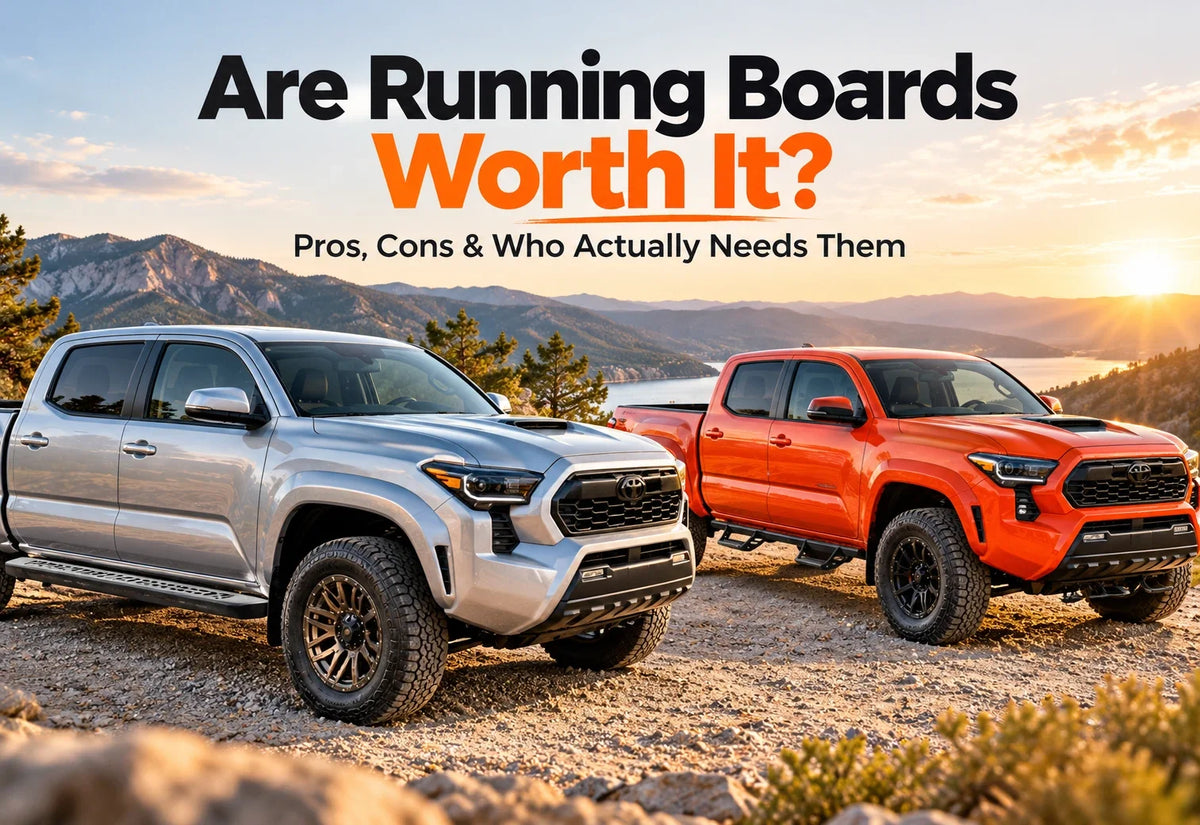
Running boards are one of those truck upgrades that seem simple until you start shopping. Some owners swear they would never own a tall pickup without them. Others remove them as soon as they start building a trail-focused truck.
So, are running boards worth it?
For many truck and SUV owners, yes. Running boards can make daily entry easier, give passengers a more predictable foothold, help with roof access, and make a taller vehicle more practical. But they also add cost, weight, and hardware below the rocker area, and some low-hanging designs can reduce usable clearance on rough terrain.
The right answer depends on who rides in your truck, how high it sits, where you drive, and what type of step you choose.
Quick Answer: Are Running Boards Worth It?
Running boards are usually worth considering if you drive a taller pickup or SUV and want easier everyday access. They are especially useful for families, older passengers, children, work-truck drivers, lifted-truck owners, and anyone who frequently reaches roof-mounted cargo.
They may be less important if your truck sits relatively low, you rarely carry passengers, or maximum off-road clearance is more important than easy cab access.
| Situation | Running Boards Worth Considering? | Why |
|---|---|---|
| Family daily driver | Usually yes | Easier entry for kids, passengers, and frequent daily use |
| Lifted truck | Often yes | Reduces the effective climb into a taller cab |
| Work truck | Often yes | Helpful when entering and exiting repeatedly during the day |
| Technical off-road build | Depends | Low-hanging boards may become contact points on rocks and ruts |
| Mostly solo driver, stock-height truck | Maybe not | The convenience benefit may be smaller |
What Do Running Boards Actually Do?
A running board creates an intermediate step between the ground and the vehicle's door sill. Instead of lifting your foot directly from the ground into a tall truck cab, you step onto the board first and then into the vehicle.
That sounds basic, but the effect can be significant on midsize and full-size pickups, especially when the truck has:
- A high factory ride height
- Larger-than-stock tires
- A suspension lift
- Passengers who have difficulty making a large step
- Roof racks, cargo boxes, or gear mounted above the cab
Modern step systems also come in different forms. A full-length running board provides a broad continuous stepping area. Drop-down running boards place the step lower for easier access. Compact side steps provide smaller individual footholds and can leave more open space under the rocker area.
If you are still comparing the basic step styles, see our guide to running boards vs. side steps vs. nerf bars.
The Pros of Running Boards
1. Easier Entry and Exit
This is the biggest reason most people install them.
A tall truck can require a surprisingly large step from the ground to the cab. Running boards break that movement into two smaller steps, which can make daily use much more comfortable.
The benefit becomes even more noticeable when getting in and out repeatedly rather than only once or twice a day.
2. Better for Families
If children regularly ride in the truck, a usable side step can make the vehicle easier for them to enter without having to pull themselves up by the seat or door opening.
The same applies when helping a child into a rear seat, loading a car seat, or managing bags at the same time.
For family trucks, a wide full-length board can be especially useful because both front and rear passengers have a large stepping area instead of one small designated pad.
3. Helpful for Older Passengers
A tall door sill can be inconvenient for anyone with limited mobility, reduced flexibility, or difficulty making a large vertical step.
A lower intermediate step can make a pickup much more passenger-friendly without changing the truck's suspension height.
This is one reason drop-down boards are popular on taller pickups: they intentionally bring the foothold closer to the ground.
4. Useful on Lifted Trucks
Lift kits improve stance, tire clearance, and off-road capability, but they also raise the cab.
That means a truck that was already tall can become noticeably harder to enter after a lift.
A properly positioned running board can restore some everyday convenience. The tradeoff is that a very low drop step may give back some of the side clearance gained by lifting the vehicle, so lifted-truck owners should pay close attention to installed step height.
5. Easier Access to Roof-Mounted Cargo
Running boards are useful even when nobody is getting into the truck.
A full-length board gives you a stable place to stand while:
- Securing a roof cargo box
- Loading skis or boards
- Strapping down kayaks
- Cleaning the roof
- Reaching roof-rack cross bars
For owners who regularly carry gear above the cab, this secondary use can make running boards more valuable than expected.
6. Convenient for Work Trucks
Contractors, technicians, fleet drivers, and other work-truck users may get in and out of the cab dozens of times during a day.
Reducing the step height can make that routine easier, especially while wearing work boots or carrying equipment.
A textured stepping surface is also useful when boots are dusty, muddy, wet, or covered with jobsite debris.
7. Can Improve Everyday Footing
A good running board gives your entire foot a predictable place to land.
That is different from trying to step directly into the cab from wet pavement, snow, gravel, or uneven ground.
Surface design matters here. Look for textured or anti-slip tread rather than choosing a board based only on appearance.
8. Changes the Truck's Side Profile
Some owners install running boards primarily for function. Others also prefer the more finished side profile they create below the doors.
Full-length boards can visually connect the front and rear wheel areas, while compact side steps create a more minimal look.
This is subjective, but appearance is a legitimate part of the buying decision when the truck is also a daily driver.
The Cons of Running Boards
1. Some Designs Reduce Usable Ground Clearance
Running boards do not lower your suspension, but they add hardware below and beside the cab.
If the board or its brackets sit significantly below the rocker panel, they can become contact points on rocks, deep ruts, curbs, snow banks, or uneven ground.
This matters most for trucks that spend time on rough trails. For a street-driven pickup, the same reduction may rarely matter in practice.
For a deeper explanation, read Do Running Boards Reduce Ground Clearance?
2. They Add Weight
Any accessory adds weight to the vehicle. A full-length steel running-board system will generally weigh more than a compact step setup.
For most daily drivers, this is not a major issue. But owners carefully managing payload or building lightweight overland setups may want to compare materials and system weight.
3. They Can Collect Mud, Snow, and Road Grime
A running board sits directly in a high-spray area of the vehicle.
That means it regularly encounters:
- Rainwater
- Road salt
- Mud
- Sand
- Gravel
- Snow and ice
The design and coating therefore matter. Open tread patterns can help shed debris, while corrosion-resistant materials and protective coatings can improve long-term durability.
4. Low Steps Can Be Vulnerable Off-Road
A low drop step is excellent for accessibility but may be more exposed on technical terrain.
This is an important distinction for off-road owners: running boards are not automatically rock sliders.
A normal side step may be designed to support a person stepping into the truck, not to support the weight of the vehicle against a rock. Unless a product is specifically engineered and rated as rocker protection, do not use it as a slider or jacking point.
5. Cheap or Poorly Fitted Boards Can Flex or Rattle
Fitment matters as much as the board itself.
A vehicle-specific system that uses the correct factory mounting points generally has a better chance of feeling solid than an improvised or poorly matched universal setup.
Before buying, confirm the exact make, model, year, cab style, mounting points, and included hardware.
6. They Cost Money Even If You Rarely Use Them
If you can easily step into your stock-height truck, drive alone most of the time, and never use the board to reach roof cargo, you may not get much practical value from one.
That does not make running boards a bad upgrade. It simply means they solve a specific problem, and not every truck owner has that problem.
Who Actually Needs Running Boards?
There is no universal rule, but several groups tend to get the most value from them.
Families With Children
A wide, stable step can make front and rear seat access easier, especially on midsize and full-size trucks that sit high from the factory.
For this use case, full-length running boards are often more convenient than small individual steps because there is more room to place a foot.
Drivers Who Regularly Carry Older Passengers
If parents, grandparents, or passengers with limited mobility frequently ride in the truck, a lower intermediate step can make a meaningful difference.
Drop-down boards can be particularly useful when ease of entry matters more than maximizing rocker clearance.
Owners of Lifted Trucks
The higher the cab gets, the more useful a side step tends to become.
Before choosing a low step, however, consider whether the truck is lifted mainly for appearance and daily driving or for serious trail use. Those two trucks may need very different step designs.
Work-Truck Drivers
If you enter and exit the cab repeatedly throughout the workday, a running board is not just a passenger convenience. It becomes part of the truck's daily workflow.
In that case, prioritize a wide usable tread, stable brackets, slip resistance, and easy-to-clean surfaces.
Owners With Roof Racks and Cargo Boxes
Standing on a full-length running board can make it much easier to reach gear mounted above the cab.
This is especially helpful for shorter drivers and for SUVs or pickups equipped with taller roof systems.
Drivers in Wet or Snowy Climates
A textured step can provide a more deliberate foothold when pavement is wet or snow-covered.
However, winter users should pay close attention to drainage, coating quality, and corrosion resistance because running boards are constantly exposed to road salt and moisture.
Who May Not Need Running Boards?
Running boards are useful, but they are not mandatory truck equipment.
You may be better off without them if:
- You can comfortably enter your truck without assistance
- You rarely carry passengers
- Your truck sits relatively low
- You do not need a step to reach roof cargo
- You are building primarily for technical off-road use
- You prioritize maximum rocker-area clearance
- You already have purpose-built rock sliders with usable step surfaces
In those cases, the extra hardware may provide less day-to-day benefit.
Full-Length Running Boards vs. Compact Side Steps
If you decide a step is worthwhile, the next question is what style to choose.
| Feature | Full-Length Running Board | Compact Side Step |
|---|---|---|
| Footing area | Large | Smaller, localized |
| Family use | Excellent | Good |
| Roof access | More standing positions | Limited to step locations |
| Open rocker area | Less open space | More open space between steps |
| Visual profile | Continuous / factory-style | Minimal / compact |
TRUMGETA currently offers both approaches. The Running Boards & Side Steps collection includes full-length boards, drop-down designs, and compact step modules for multiple truck and SUV applications.
Are Drop-Down Running Boards Worth It?
Drop-down running boards are worth considering when reducing step-in height is the priority.
They are especially practical for:
- Lifted trucks
- Families
- Older passengers
- Taller factory pickups
- Drivers who enter and exit frequently
The current TRUMGETA 2024-2026 Tacoma drop-down system uses a lower step position, aluminum construction, textured tread, factory mounting locations, and a listed 600 lb capacity for its supported application.
The compromise is clearance. A lower step is easier to reach but sits closer to obstacles, so trail-focused owners should evaluate how far the step hangs below the rocker panel.
Are Compact Side Steps Worth It?
Compact side steps can be a strong option for owners who want easier cab access without installing a full-length board.
Because each step is located only where a passenger needs it, more of the rocker area remains open.
TRUMGETA's Auxchemic® Side Steps are one example of this approach. The current Tacoma application uses independent compact modules, factory mounting locations, a textured protective surface, and a listed 350 lb capacity.
That style may make sense if you care about:
- A smaller visual footprint
- Less hardware running the full length of the cab
- Mixed daily-driving and rough-road use
- Dedicated rather than continuous stepping points
Are Running Boards Worth It for a Toyota Tacoma?
For many Tacoma owners, they can be.
The Tacoma is used in very different ways: daily commuting, family trips, worksites, camping, overlanding, and trail driving. That makes step choice more important than simply deciding whether to install one.
For 2024-2026 Tacoma applications, TRUMGETA currently offers multiple configurations, including 5-inch and 5.5-inch full-length boards, a 600 lb drop-down design, family-focused boards, compact side steps, and Auxchemic® side steps.
A daily-driven Double Cab carrying children may benefit most from a wide full-length board. A lifted Tacoma may benefit from a lower drop step. A driver who wants less hardware below the rocker area may prefer compact individual steps.
Always confirm exact cab style before ordering. Some full-length Tacoma boards are designed for Double Cab / Crew Cab applications and are not intended for XtraCab.
Do Running Boards Protect Your Truck?
They can provide some incidental shielding from small stones, road spray, and minor everyday contact simply because they occupy space below the doors.
But ordinary running boards should not be treated as structural rocker protection unless the manufacturer specifically designed them for that purpose.
If your main goal is protecting the body while rock crawling, shop specifically for rock sliders or other armor designed for vehicle impacts.
Do Running Boards Hurt Fuel Economy?
Any accessory that adds weight or changes airflow can theoretically affect efficiency, but the practical effect of fixed running boards varies by vehicle, design, speed, and driving conditions.
For most buyers, accessibility, clearance, fitment, and durability are more useful purchase considerations than trying to predict a small fuel-economy change from the board alone.
What Should You Look for Before Buying Running Boards?
Exact Vehicle Fitment
Do not stop at the model name. Confirm model year and cab configuration.
A board designed for a Tacoma Double Cab may not fit an XtraCab, and different generations can use different mounting points.
Installed Step Height
The board needs to be low enough to actually help. If it sits almost level with the door sill, it may preserve clearance but provide little accessibility benefit.
Ground Clearance
Look at the lowest point of the complete assembly, including brackets.
This is especially important for owners who drive on rocks, ruts, construction sites, ranch roads, snow, or uneven campsites.
Step Width and Surface
A larger tread generally gives you more room for work boots and everyday passenger use. Compact steps trade some of that space for a smaller footprint.
In either case, look for a textured surface that gives wet or muddy footwear a defined place to land.
Material and Finish
Both steel and aluminum can work well when the overall design is appropriate.
Steel provides strong, rigid construction but depends heavily on coating quality for corrosion protection. Aluminum reduces weight and naturally resists rust, though the complete bracket and fastener system still matters.
Installation Method
Vehicle-specific bolt-on systems that use factory mounting locations can simplify installation and avoid unnecessary drilling.
Check what hardware is included and whether the product requires modifications before ordering.
How to Decide in 60 Seconds
Ask yourself five questions:
- Is my truck difficult for me or my passengers to enter?
- Do children or older passengers ride in it regularly?
- Do I frequently reach roof-mounted cargo?
- Is the truck mainly used on pavement, or do I need maximum trail clearance?
- Would I prefer a wide continuous step or smaller dedicated footholds?
If the first three answers are mostly yes, running boards are likely to add noticeable everyday value.
If maximum clearance is the dominant priority, compare compact steps or purpose-built off-road protection before choosing a low full-length board.
Final Take: Are Running Boards Really Worth It?
Running boards are worth it when they solve a real access problem.
For families, lifted-truck owners, older passengers, work-truck drivers, and people who regularly load roof gear, they can become one of the most-used accessories on the vehicle.
For a solo driver with an easy-to-enter stock-height truck, the benefit may be smaller. And for serious trail use, a low-hanging board may create more compromise than convenience.
The best approach is to choose around how your truck is actually used rather than buying the biggest or lowest step available.
Explore TRUMGETA Running Boards & Side Steps to compare full-length boards, drop-down designs, and compact side steps for supported Toyota, Ford, RAM, Jeep, and other truck applications.
Frequently Asked Questions
Are running boards worth the money?
They can be if easier entry, passenger accessibility, or roof access matters to you. Their value is lower for drivers who rarely use the step or prioritize maximum off-road clearance.
What are the main disadvantages of running boards?
The main tradeoffs are added cost and weight, exposure to mud and road salt, and possible reduction in usable side clearance when the board or brackets hang low.
Do running boards help older people get into trucks?
Yes. A well-positioned intermediate step can reduce the vertical climb into a tall cab, which can make entry easier for older passengers or anyone with limited mobility.
Are running boards worth it on a lifted truck?
Often yes, because lifting the truck raises the cab. However, very low drop steps may reduce some of the side clearance gained from the lift, so the right design depends on how the truck is used.
Are running boards good for kids?
They can make it easier for children to enter a tall truck. Wide full-length boards usually provide more room for foot placement than small individual steps.
Are running boards bad for off-roading?
Not automatically. High-mounted or compact designs can work well for light trails and rough roads. Low-hanging boards are more exposed on technical terrain, and ordinary running boards should not be treated as rock sliders unless specifically designed for that purpose.
Are full-length running boards better than side steps?
They are better for some uses. Full-length boards provide more stepping area and are convenient for families and roof access. Compact side steps leave more of the rocker area open and can suit drivers who want a smaller footprint.
Do running boards reduce ground clearance?
They can reduce effective side clearance if the board or brackets hang below the rocker panel. The amount depends on the specific design and installation position.
Should I choose aluminum or steel running boards?
Both can be good choices. Aluminum is lighter and naturally corrosion-resistant, while steel offers strong, rigid construction. Overall design, brackets, surface finish, fitment, and coating quality are just as important as the base material.
What type of running board is best for daily driving?
For many daily drivers, a wide full-length board mounted close to the body offers a useful balance of passenger access and everyday practicality. Taller or lifted trucks may benefit more from a lower drop-step design.

Leave a comment
This site is protected by hCaptcha and the hCaptcha Privacy Policy and Terms of Service apply.