
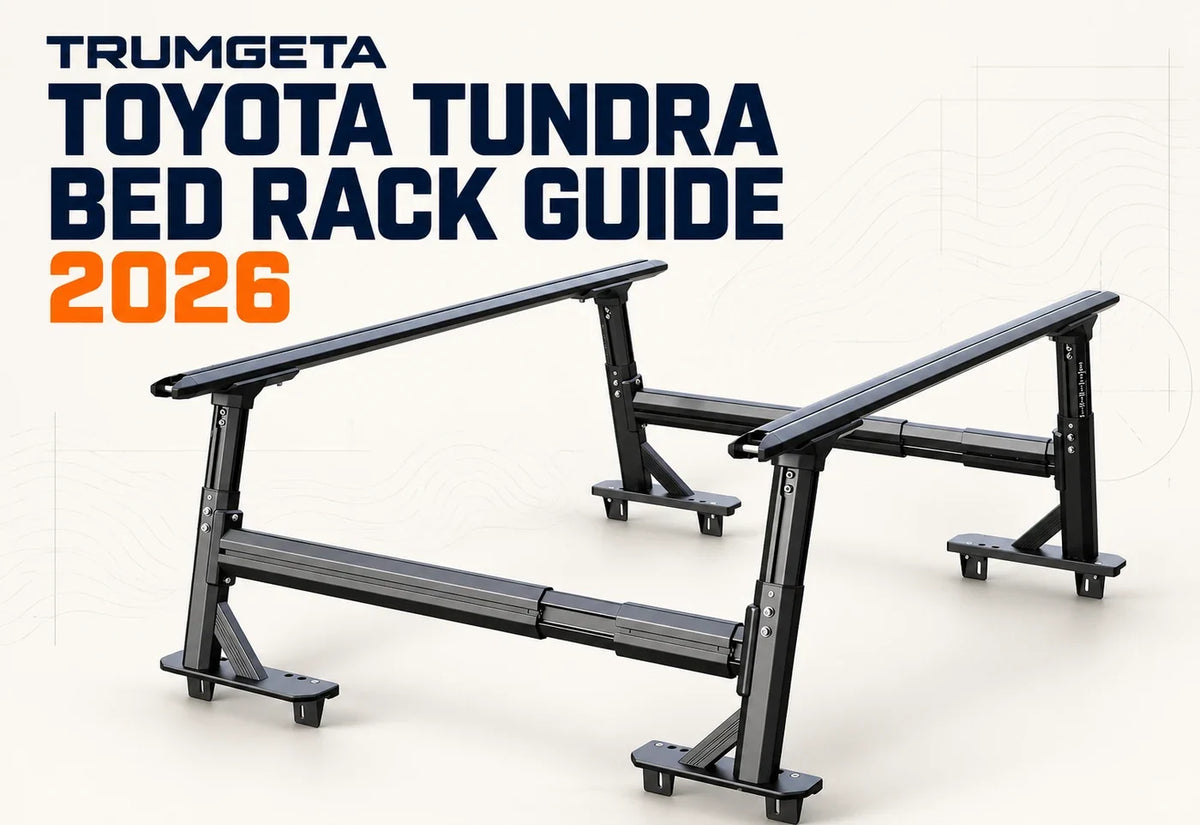
The best Toyota Tundra bed rack is the one that fits your actual bed and mounting system while giving your equipment the support and access it needs. Full-size dimensions alone do not settle the choice. Model year, bed length, factory rails, a retained cover, and the complete cargo arrangement all matter.
Quick answer: Compare TRUMGETA ULTRA for a factory-inner-rail setup, Leitner ACS FORGED for a storage-oriented frame, Küat IBEX for a configurable frame, Yakima OverHaul HD for adjustable-height bars, and BillieBars for a lower bar arrangement. First confirm the exact Tundra application, then compare the complete installation.
This guide uses manufacturer information checked October 31, 2026. It covers shopping options for Tundra owners across different model years. It is an application-based shortlist, including TRUMGETA's own product, rather than a comparative load test or a universal performance ranking.
Start With Your Tundra's Actual Bed
The guide year is separate from the truck's model year
A 2026 buying guide can help someone shopping for a rack for an older Tundra as well as a current truck. Compatibility still belongs to the actual vehicle application. Do not extend an earlier rack's fit simply because the truck name is unchanged.
Record the model year, cab, bed length, factory rails or tracks, liner, cover, and existing storage. Keep these details beside every candidate's part number. A product family can contain several Tundra configurations with different mounting parts.
Keep the 8.1-foot long bed in the comparison
Toyota's official 2026 Tundra brochure lists 5.5-foot short, 6.5-foot standard, and 8.1-foot long beds, with availability depending on configuration. An aftermarket rack selector that offers only two lengths does not establish that Toyota offers only two beds.
For an 8.1-foot truck, request an explicitly supported rack arrangement. A rack does not necessarily have to cover the whole bed, but its mounting positions, support spacing, and permitted application still need to match the truck. Do not substitute a short- or standard-bed selection without confirmation.
Similarly, an older Tundra rack listed for an 8-foot bed does not automatically establish fit for a later 8.1-foot bed. Use the year and mounting requirements together with the length.
Five Toyota Tundra Bed Rack Systems to Compare
These are starting points for different layouts. Fit notes identify what the current documentation establishes and what still needs confirmation.
On a phone, swipe the table horizontally.
| System | Layout to investigate | Important Tundra check | Configuration qualification |
|---|---|---|---|
| TRUMGETA ULTRA C1998V01 | Adjustable rack for factory inner rails | Exact year, bed, rail geometry, and equipment | Published load statements conflict; request a current SKU-specific specification |
| Leitner ACS FORGED Toyota | Framed layout with optional GearPOD storage | Separate older and 2022+ Tundra parts | Current 2022+ selections list 5-foot-6 and 6-foot-6 beds; 8.1-foot fit is not established by those selections |
| Küat IBEX | Full- and mid-height frame configurations | IBEXB2 short-bed and IBEXD2 medium-bed groups | Use exact vehicle fit and terrain restrictions; do not infer an 8.1-foot application |
| Yakima OverHaul HD | Height-adjustable bar system | Tundra-specific fit, bars, and track or cover hardware | Base-system limits do not automatically cover every adapted setup |
| BillieBars Tundra low-profile rack | Lower bars with removable crossbars | Year group and with/without Toyota track-rail brackets | Cover, drain-channel, and factory-storage conditions can change mounting |
Current Tundra Bed Rack Options
TRUMGETA ULTRA: Investigate the Factory-Inner-Rail Application
The TRUMGETA ULTRA C1998V01 listing includes rail-equipped Tundra applications and excludes trucks without bed rails. The description identifies adjustable height and width, with four height levels between 19 and 25 inches.
Start with the actual rails fitted to the truck. Ask TRUMGETA to confirm the model year, bed length, mounting interface, equipment support, and any cover combination. Inclusion in a Tundra collection should not replace that check.
The current page gives different load statements in its headline features, technical table, and description. Obtain a current specification for C1998V01 and your configuration before using it to plan a load. This guide does not select the largest published figure or treat the different statements as interchangeable.
Useful comparison: An adjustable rail-based arrangement when the intended equipment and truck are supported. Check clearance above bed cargo, the actual bracket arrangement, and access to the mounting points before adding accessories.
Leitner ACS FORGED: Compare Storage and Bed-Length Variants
The Leitner ACS FORGED Toyota listing separates Tundra selections by year and bed. Current 2022+ choices include 5-foot-6 and 6-foot-6 beds, with their own part numbers. Older Tundra selections include additional configurations, including an 8-foot option for 2007–2021 trucks.
The standard FORGED system describes a 23-inch frame, accessory rails, a sliding load bar, and optional locking GearPOD storage. Consider the storage and upper equipment together: a container can occupy a useful side position while also needing space for its lid and removal.
Keep the standard FORGED, no-drill, and tonneau families separate. Features and mounting procedures should not be transferred between them. A rack's relationship to a cover can also change the complete configuration.
Useful comparison: A build organized around dedicated accessible storage. For a current 8.1-foot bed, request the appropriate supported arrangement; an earlier 8-foot variant or another current bed selection is not confirmation by itself.
Küat IBEX: Match the Frame Group to the Actual Bed
The Küat IBEX offers full- and mid-height configurations. Its official parts information identifies IBEXB2 for 2007–2026 Tundra short beds and IBEXD2 for 2007–2026 Tundra medium beds.
Match those labels through the vehicle-fit process. They are not permission to choose whichever frame looks closest to an 8.1-foot bed. Confirm the required attachment parts and the complete equipment layout.
The IBEX user guide lists 300 pounds dynamic and 1,200 pounds static and excludes specified technical terrain, including rock crawling, jumping, bogging, and high-speed off-road use. The intended route remains part of the buying decision.
Useful comparison: A configurable frame for a supported Tundra fit group. Evaluate the selected height, bar positions, accessory mounts, and actual instructions together.
Yakima OverHaul HD: Adjustable Bars for Changing Cargo
The Yakima OverHaul HD uses HD Bars and offers 19–30-inch height adjustment. Its bar-based layout is worth comparing when the truck carries different equipment and needs different clearance arrangements.
Build the parts list around the current Tundra fit information. Bar length, tracked-bed hardware, and any cover adapter are separate purchasing decisions. A base-system listing should not be mistaken for an automatically complete Tundra package.
Check the instructions for the actual bar spread and adapters before applying a published load rating. Retaining a cover can change the mounting arrangement and the relevant limits. Verify the full setup rather than carrying the base specification through every combination.
Useful comparison: Adjustable-height bars with compatible equipment mounts. Measure upper cargo and cab clearance from the installed support surface, and confirm that a practical height setting also meets the equipment's support requirements.
BillieBars: Lower Bars With Specific Rail and Cover Conditions
The BillieBars Tundra low-profile rack offers 5- and 8-inch bracket choices, with separate with-track and without-track selections. Its current selector also separates older trucks from 2022+ applications.
The crossbars can be removed while the brackets remain. That is useful to compare when upper cargo support is occasional and the truck regularly needs open access above the bed.
Check the actual underside clearance. The page lists 3.5 inches for the 5-inch brackets and 6.5 inches for the 8-inch brackets. The bracket label and usable clearance are different measurements.
BillieBars also flags mounting differences with certain factory-cover or BakFlip arrangements involving an internal drain channel, and with factory storage boxes. Ask about the exact truck and cover instead of extending the general cover-compatible description.
Useful comparison: A lower arrangement with a supported cover and truck application. Confirm the selected rail condition, underside clearance, and the full movement of the retained cover.
Evaluate Rails, Covers, and Existing Bed Equipment Together
Inspect the mounting interface
Toyota's current brochure identifies an aluminum-reinforced composite bed. Follow the actual rack and vehicle installation requirements for its mounting interface. Do not infer that any clamp intended for a steel-bed truck is appropriate for a different bed design.
Identify the rail or track profile, bracket engagement, fasteners, and any required support components. Keep the mount accessible for inspection after the equipment is installed. A product described as rail-mounted still needs the correct rail and hardware.
For an older truck, use its actual installation requirements. A newer vehicle's rack can use a different interface even when both listings say Tundra. Transferring an existing rack needs a fresh application check.
Check the cover through its full movement
Test the planned layout on paper in three positions: cover closed, cover opening, and cover fully open. Include folded panels, a rolled cover, or a retracting canister. A rack can leave room above the bed while obstructing the cover's normal path.
Use the exact cover make and model in fit questions. Add rail photographs and storage details when requested. Keep any required adapter and its instructions in the complete parts list.
Include boxes, liners, and daily-use equipment
A storage box can interfere with a bracket or block a fastener even when it sits below the upper bars. Check latches, lids, power-outlet access, and the space needed to remove containers.
Consider how the bed is used on an ordinary day, not only at camp. Make sure the arrangement allows loading, unloading, and inspection without repeatedly dismantling equipment that was intended to remain installed.
Compare Height, Ground-Level Reach, and Usable Clearance
Measure from the installed equipment-bearing surface. “Low,” “mid,” and “cab height” are not standardized dimensions across brands. Confirm whether a listed height refers to a bracket, the underside of a bar, or the top support surface.
The BillieBars example shows why that distinction matters. A cargo case that appears to fit beneath an 8-inch label needs to be checked against the published underside clearance and the actual opening space for its lid.
For a tent, compare the packed tent, mounts, and rack height together. Then check the opening envelope, ladder position, and access to equipment below it. A lower travel position can create a different access problem at camp.
Work through frequent tasks from the ground where practical. Can you release a board mount, open a side container, inspect the rack attachment, and remove a daily-use item? Measure the actual reach rather than relying on an installed product photograph.
For long cargo, check front-to-rear support spacing separately from overall rack height. Clearance above the cab does not establish the required support or restraint arrangement. Do not bridge a cab rack and bed rack unless that configuration is approved.
Measure the truck's overall loaded height once the supported layout is installed. Update the record when the tent, mounts, or upper equipment changes. The unloaded vehicle's height will not describe every carrying arrangement.
Use a dimension sheet for the actual equipment
Write down which surfaces each measurement uses. Exterior bed width, distance between mounting points, and usable space inside the bed are different dimensions. Send the measurement requested by the rack manufacturer rather than substituting whichever one is easiest to take.
| Measurement | What it helps check |
|---|---|
| Required rack mounting span | Whether the actual rail and bracket arrangement is supported |
| Cargo-bearing surface to cab clearance | The intended upper equipment position |
| Clearance below the bars | Container height and space for lids or slides |
| Equipment support spacing | Whether the cargo's required attachment positions can be achieved |
Include a drawing when several accessories share the same area. Mark their opening and removal paths as well as their packed outlines. This can reveal an access conflict before it becomes a missing adapter or an unsuitable rack order.
Read Load Categories Alongside Equipment Support
Keep static and traveling conditions separate
A stationary maximum is not a traveling allowance. Preserve the manufacturer's categories, distribution conditions, route restrictions, and any reductions associated with the actual installation. Missing information should be clarified rather than estimated from a larger number.
Resolve conflicting statements by exact SKU and configuration. Request the current instructions or written specification and keep the response with the order. Do not average ratings or choose one favorable statement from several different versions.
Count all rack-carried equipment
List the upper cargo, tent mounts, awning and brackets, accessory panels, side equipment, and storage. Check whether an equipment weight includes its hardware. Use actual weights rather than a visual estimate of how heavy a complete setup looks.
Follow each system's definition of its rating, including any required treatment of rack weight. Check individual accessory attachments as specified. A side bracket's stated capacity is not automatically an allowance added to the main rack maximum.
Check the truck separately
The vehicle carries the rack itself, people, supplies, bed storage, and other added equipment. Follow the vehicle's load information and applicable limits. A higher-rated rack does not increase the truck's permitted carrying load.
Use the heaviest intended trip or work configuration. Moving a supply container from the rack into the bed changes its position and support needs while leaving its weight on the vehicle.
Build a Shortlist for Your Actual Tundra
A current short- or standard-bed camping build
Start with current explicit application information, such as the appropriate Leitner 2022+ variant or a supported IBEX fit group. Compare storage access, tent support, and cover operation after verifying the exact parts.
Add the TRUMGETA inner-rail option after confirming the truck application and resolving the applicable load specification. This makes the comparison about supported complete setups.
An 8.1-foot work or camping truck
Send the model year and actual bed length to each shortlisted manufacturer. Ask where its rack mounts, which parts are required, and whether the intended upper equipment is supported. A length omitted from a selector requires clarification.
Retain the benefit of the longer bed when planning the layout: decide which items need open vertical loading space and which can be reached beneath the rack. Verify the proposed attachment positions before ordering.
A covered daily driver
Begin with the exact cover and desired underside clearance. Investigate a supported low-profile arrangement when it meets the cargo requirements, or compare a compatible higher setup if the equipment needs it.
Work through cover opening, daily cargo removal, and any planned crossbar removal. The most useful configuration is the one that supports those repeated tasks as well as the occasional larger load.
Compare Complete Orders and Keep the Setup Documented
Ask each supplier to identify the frame or towers, bars, truck hardware, cover adapters, equipment mounts, and optional storage needed for the same intended use. Separate included parts from additions before comparing quotations.
Check availability and fulfillment for the entire set when ordering. An orderable rack does not establish that every necessary adapter is ready for the same installation date. Keep the confirmed part numbers and applicable instruction revisions.
After installation, rehearse the actual loading and access sequence on a suitable site. Follow the manufacturer's inspection and maintenance procedure. Recheck the affected fit, weight, support, and clearance requirements after changing the equipment or moving the rack to another truck.
Planning a TRUMGETA Tundra setup? Explore TRUMGETA Tundra accessories and send your model year, bed length, rail, cover, and equipment details to confirm the appropriate rack and current installation specification.
Frequently Asked Questions
What are the best Toyota Tundra bed racks in 2026?
Compare supported configurations for your actual truck. This guide covers TRUMGETA ULTRA, Leitner ACS FORGED, Küat IBEX, Yakima OverHaul HD, and BillieBars for different layouts. Choose through fit, equipment support, access, cover operation, and applicable use limits.
Does the 2026 Tundra have an 8.1-foot bed?
Toyota's official 2026 brochure lists an available 8.1-foot long bed alongside 5.5- and 6.5-foot configurations. Check your actual cab and bed combination. A rack selector showing fewer lengths does not define the truck's entire available bed range.
Will a 2007–2021 Tundra rack fit a 2022+ truck?
Do not assume it will. Manufacturers can use different frames, hardware, or interfaces across those applications. Verify the exact rack and truck through current fit information before transferring equipment. A familiar Tundra name or similar bed length is not sufficient.
Can I retain a tonneau cover with a Tundra rack?
A supported combination may permit it. Check the exact cover, rails, adapters, and normal opening movement. Drain channels, canisters, folded panels, and factory storage can affect the installation. Confirm the complete arrangement with the applicable manufacturers.
Is bracket height the same as clearance under the bars?
No. For example, the referenced BillieBars page lists 3.5-inch underside clearance with its 5-inch brackets and 6.5 inches with its 8-inch brackets. Use the actual measurement reference and check container lids and removal paths too.
Is TRUMGETA ULTRA C1998V01 approved for every Tundra?
The listing includes Tundra among rail-equipped applications and excludes trucks without bed rails. Confirm your exact model year, bed, rail geometry, equipment, and cover. The current page's load statements differ, so obtain the applicable SKU-specific specification before planning the load.
Does a large static rating approve a rooftop tent setup?
A static number alone does not establish tent compatibility. Verify support spacing, bar or platform dimensions, clamps, traveling weight, and occupied-use instructions. The truck, rack, adapters, tent, and mounts all retain their own applicable requirements.
What should I send when requesting Tundra rack fit confirmation?
Provide the model year, cab, bed length, rail or track details, liner, cover make and model, storage, and intended equipment. Include route conditions and photographs when relevant. Ask for the exact parts and current instructions for that complete configuration.

Leave a comment
This site is protected by hCaptcha and the hCaptcha Privacy Policy and Terms of Service apply.