
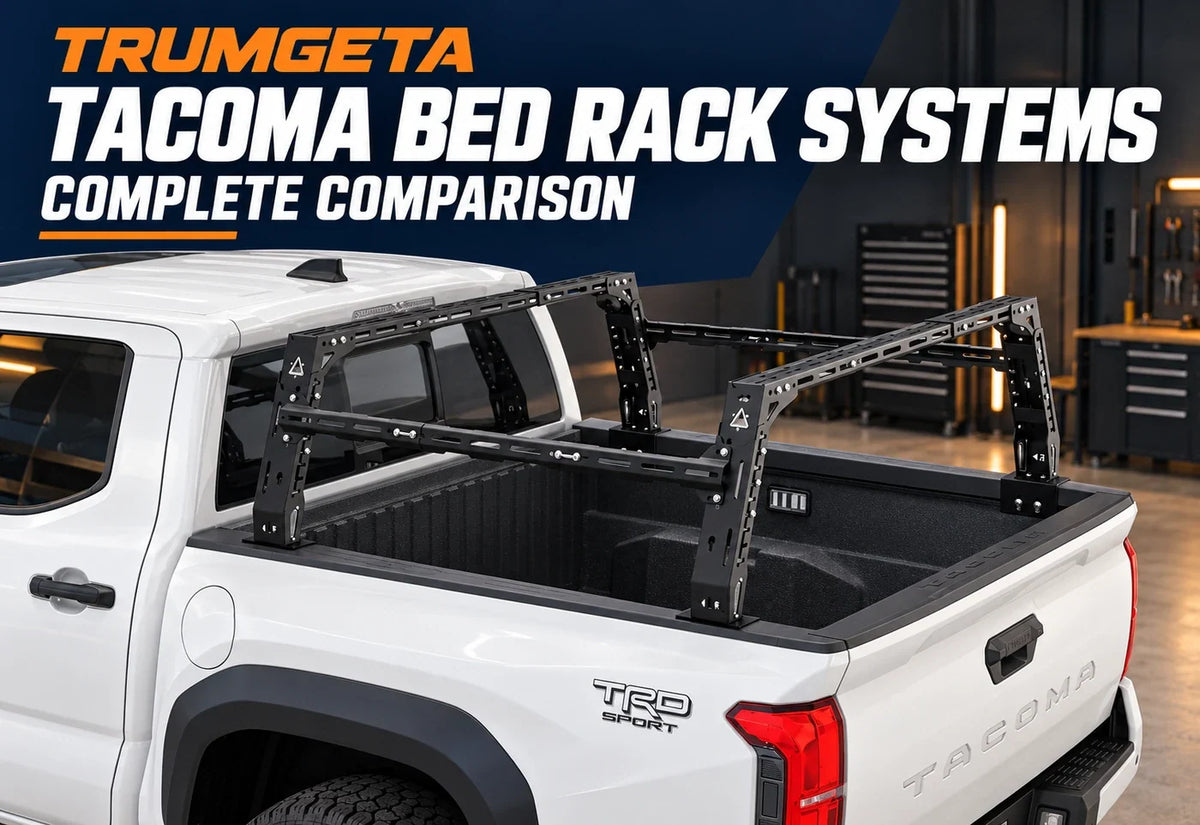
A Toyota Tacoma bed rack system is more than the frame pictured above the truck. The finished installation also depends on the vehicle mounts, cargo-bearing bars or platform, equipment brackets, and any hardware needed to retain a tonneau cover. Comparing those pieces together makes the purchase easier to understand.
Quick answer: Choose the supported truck interface first, then compare the complete parts needed for your cargo. A framed rack, adjustable bar system, and cover-mounted arrangement can each work well for a suitable application. The best Tacoma system is the complete supported combination that meets your fit, equipment, access, and use requirements.
This comparison examines six current system approaches using manufacturer information checked November 1, 2026. It includes TRUMGETA products and other manufacturers' examples. The focus is configuration and package contents; no independent load or durability testing was performed.
What Makes a Tacoma Bed Rack a Complete System?
Think of the installation as a chain of connected components. Each connection needs the right parts and an applicable instruction. Buying a frame does not automatically resolve how it attaches to the truck or how the cargo attaches to it.
- Vehicle interface: The hardware that connects the system to the supported bed rails, tracks, clamps, or cover channels.
- Main structure: The frame, uprights, or towers selected for the actual Tacoma application.
- Cargo support: The bars or platform required by the equipment, with suitable dimensions and spacing.
- Equipment attachment: The approved clamps, brackets, or restraints connecting the cargo to its support.
- Optional functions: Storage, side equipment, cover adapters, and other additions that remain within the complete configuration's requirements.
Package names do not tell you whether every part in that chain is included. Ask for an itemized list for the actual truck and equipment. This also helps prevent buying the same component twice when one bundle includes parts sold separately elsewhere.
Toyota Tacoma Bed Rack Systems Compared
These examples represent different approaches to assembling a supported installation. They are not a ranking of measured strength or an exhaustive list of every Tacoma rack.
On a phone, swipe the table horizontally.
| System example | Main approach | Package distinction | What to specify |
|---|---|---|---|
| TRUMGETA C1902V01 | Slotted framed rack | Platform excluded | Tacoma with-bed-rail application and equipment support |
| TRUMGETA ULTRA C1998V01 | Adjustable factory-inner-rail rack | Distinct family from C1902V01 | Actual rail fit, complete components, and clarified load specification |
| Leitner ACS FORGED Toyota | Frame with optional integrated storage | GearPOD storage is optional; rack families differ | Generation, bed length, selected version, and storage layout |
| Yakima OverHaul HD | Height-adjustable towers and bars | Referenced towers-only listings require separate HD Bars | Bars, truck or cover hardware, and equipment mounts |
| Küat IBEX | Full- or mid-height frame configuration | Vehicle fit groups and compatible parts are SKU-specific | Correct frame group, hardware, and upper equipment arrangement |
| BillieBars Tacoma T-slot cover rack | Bars mounted through a supported cover's channels | Listed kit includes two crossbars and mounting brackets/hardware | Truck year group, bed, height, and exact cover |
Current Tacoma System Examples
TRUMGETA C1902V01: A Frame With Separate Platform Planning
The TRUMGETA C1902 family separates its selected full-size no-rail applications from the C1902V01 Tacoma/Gladiator with-bed-rail variant. Listed height settings are 18.8, 22.5, and 25 inches.
The platform is not included. Decide whether the intended cargo requires a separate platform or another supported attachment arrangement before comparing the package with a platform-based system.
The description lists 300 pounds dynamic and 600 pounds static. It does not establish a separate off-road category. The steel-or-aluminum construction wording also needs exact-variant clarification.
System question: Which truck hardware and equipment-support components complete the C1902V01 installation for your Tacoma? Confirm the model year, bed, cover if retained, and actual cargo before ordering additions.
TRUMGETA ULTRA C1998V01: A Different Adjustable Rail-Based Family
The TRUMGETA ULTRA C1998V01 is designed around factory inner bed rails. Its description identifies four height levels between 19 and 25 inches and adjustable width.
Treat it as its own system. Its appearance, mounting components, and instructions should not be replaced with C1902 assumptions just because both products are adjustable TRUMGETA racks.
The current ULTRA page contains inconsistent load statements across its headline features, technical table, and description. Request the current specification for C1998V01 and the intended configuration before planning the carried load. This comparison assigns no definitive capacity to that unresolved information.
System question: Does the exact truck and rail arrangement support this SKU, and which components and use limits apply to the complete installation?
Leitner ACS FORGED Toyota: Plan Storage With the Rack Version
The Leitner ACS FORGED Toyota selector distinguishes 2005–2023 Tacoma applications from 2024+ applications, with separate short- and long-bed choices.
The standard FORGED description includes a 23-inch frame, accessory rails, a sliding load bar, and optional locking GearPOD storage. The storage can be part of the system plan, but it should also be part of the parts list, load record, and access drawing.
Compare the actual selected version. Standard FORGED, no-drill, and tonneau families should not be combined into one description with every favorable feature. Confirm the installation procedure and included components for the chosen version.
System question: Which frame, vehicle parts, storage units, and equipment mounts are included in the proposed Tacoma configuration, and can they operate together as intended?
Yakima OverHaul HD: Count the Bars and Interface Hardware
The Yakima OverHaul HD towers-only listing includes four towers, offers 19–30-inch adjustment, and requires HD Bars sold separately. Tracked beds and selected covers need additional kits.
The OverHaul HD Tonneau Set includes four towers and tonneau mounting hardware, while its HD Bars are also separate. Its “complete system” description should be read alongside that actual component list.
For a Tacoma, select the supported vehicle or cover interface before choosing the rest of the package. Bar length, equipment mounts, and any side accessories remain part of the complete setup.
System question: Does the quotation include the correct bars and all interface parts, or only the towers and one mounting package?
Küat IBEX: Match Components Through the Correct Fit Group
The Küat IBEX provides full- and mid-height configurations. The official parts information lists IBEXA1 for 2005–2026 Tacoma short beds and IBEXC1 for 2006–2026 Tacoma long beds.
Use the actual vehicle-fit process and SKU when selecting the complete installation or replacement components. A shared product-family name is not enough to establish that every part can be exchanged between frame groups.
The IBEX guide publishes 300 pounds dynamic and 1,200 pounds static, with explicit exclusions including rock crawling, jumping, bogging, and high-speed off-road use.
System question: Which frame group, height configuration, installation parts, and equipment mounts form the supported arrangement for this truck and route?
BillieBars T-Slot Cover Rack: The Cover Is Part of the System
The BillieBars Tacoma rack for covers with T-slots is built around a supported cover's integrated channels. Its current selections separate 2005–2015, 2016–2023, and 2024-present trucks, 5- and 6-foot beds, and four height choices.
The description lists two crossbars and the brackets and hardware for the supported cover arrangement. Check the exact cover through the manufacturer's fitment process; a cover brand name alone does not define every rail profile.
This is a different installation approach from mounting a rack directly to factory bed tracks while also retaining a cover. The interface determines which parts and requirements need to be checked.
System question: Which year, bed, height, cover, and mounting combination is being quoted, and can the cover operate with the intended upper equipment?

Factory Bed Rails and Tonneau Tracks Are Different Interfaces
The word “rail” can describe more than one component. A factory track inside the bed and a channel along a tonneau cover are different mounting locations. Identify which one the proposed rack uses.
Record the actual truck year, bed length, rail profile, liner, cover make and model, and existing storage. Then match that information to the selected rack and interface hardware. A broadly compatible frame does not make every bracket suitable for every Tacoma.
Ask whether the rack attaches independently of the cover or through a supported cover channel. This helps identify the relevant adapters, instructions, and load conditions. Do not substitute visually similar T-bolts or plates without an approved specification.
Check cover movement with all equipment in place. Closing clearance, folding or rolling movement, and the fully open position are separate tasks. Include the space needed by a retracting canister, container lid, or mounted accessory.
When a listing's fit wording conflicts with its variant selector, stop at the exact SKU. Obtain current application information instead of expanding the year range or combining hardware from two versions.
Compare the Cargo Support Surface and the Equipment Mount
A platform and a pair of bars are different support arrangements. Start with the equipment's instructions for support dimensions, clamp geometry, and spacing. The right arrangement depends on what the cargo requires.
A rack with no platform is not automatically missing a necessary part. Some equipment can use a supported bar arrangement, while another item may require a specified platform or additional support. Resolve that requirement before filling the quotation with accessories.
Measure front-to-rear support spacing separately from crossbar width. Also identify the equipment-bearing height and clearance below it. Similar low, mid, or tall labels do not establish equivalent assembled dimensions across brands.
Trace each accessory's connection to the rack. A channel provides a place for compatible hardware; it does not approve any weight, bracket, or mounting direction that physically fits. Check the accessory and receiving component together.
For a tent, compare the packed travel installation and occupied camp arrangement separately. Check opening direction, ladder support, and access to the bed. A rack's static number alone does not resolve those requirements.
Why a Different Configuration Can Have a Different Rating
Load categories belong to the actual system and use. Preserve the manufacturer's static, dynamic, on-road, and off-road definitions, distribution requirements, and route restrictions.
Yakima offers a clear example. Its base OverHaul HD listing publishes 500 pounds on-road and 300 pounds off-road. The referenced Tonneau Set listing publishes 300 pounds on-road and 180 pounds off-road. The rack family name remains familiar while the mounting arrangement and applicable figures differ.
Read the current instructions for the actual vehicle, bar spacing, adapters, and cargo. Do not invent a combined reduction formula or transfer one manufacturer's rule to another system.
Include cargo brackets, storage, and other rack-carried equipment in the worksheet as instructed. Separately account for the rack, passengers, bed cargo, and other additions under the vehicle's load requirements. Buying a higher-rated rack does not increase the truck's permitted load.
Two Ways to Specify a Complete Tacoma Build
Build A: An uncovered truck with upper camping equipment
Start by recording the actual Tacoma application and factory mounting interface. Select a supported frame or tower package, then specify the bars or platform needed by the tent or other upper cargo.
Add the equipment-specific mounts, any supported side accessories, and optional storage. Record the actual weights and intended route. Check that the proposed layout leaves access to truck mounts and container openings.
Compare quotations for that same equipment list. A package with an included support surface may require fewer additions than a towers-only listing, while another layout may meet the requirement with separate bars. The relevant comparison is the supported finished arrangement.
Build B: A covered truck that needs upper cargo space
Begin with the cover make, model, rail arrangement, and full movement. Determine whether the supported rack mounts directly to the truck or through the cover's channels.
Specify the correct interface package and its current requirements before adding bars, equipment mounts, and cargo. Check whether any item already included in a bundle appears again as a separate accessory in the quotation.
Rehearse cover opening, equipment removal, and normal bed access in the proposed layout. Retaining a cover is useful when the complete arrangement still performs those everyday tasks.
Use the Same Quotation Checklist for Every System
An itemized quotation makes different product families easier to compare. Ask each supplier to identify which components are included, required separately, or optional for the intended build.
| Item to identify | What the quotation should establish |
|---|---|
| Truck application | Model year, bed length, rails, cover, and selected SKU |
| Vehicle attachment | Required brackets, adapters, and installation hardware |
| Main rack structure | The exact frame or tower version and included components |
| Cargo support | Bars or platform, dimensions, and supported positions |
| Equipment mounts | The parts connecting each cargo item to its support |
| Storage and accessories | Optional additions, weight, clearance, and attachment requirements |
| Instructions and fulfillment | Current configuration documents and availability of all required parts |
Check the complete order's fulfillment terms when purchasing. An available rack does not establish that every adapter or mount can be supplied for the same installation date. Keep the confirmed component list with the order.
Compare Removal, Adjustment, and Replacement Parts
Identify what stays on the truck
Removal is a system procedure. Ask which components come off together, which mounts remain installed, and what must be unloaded first. A frame with side equipment and upper cargo can involve a different sequence from the same frame with no accessories.
Yakima describes a QuickChange attachment for the OverHaul HD. Check the actual removal and reinstallation instructions for the assembled setup rather than interpreting that feature as a timed promise for every loaded configuration.
Plan a suitable storage location for removed parts and protect the components as instructed. Keep vehicle-specific pieces identified so they return to the correct installation.
Check adjustment with the equipment fitted
An adjustable height range describes available positions; it does not tell you the entire adjustment process. Determine which fasteners must be reached, whether cargo must be removed, and how the revised position is secured and inspected.
Check how side equipment, storage, and tent mounts affect that access. If changing the arrangement is a frequent task, compare the documented procedure with the space and tools you actually have. Do not assume a visible adjustment slot makes a loaded system suitable for adjustment.
Specify replacement parts by configuration
Ask how the manufacturer identifies replacement feet, bars, fasteners, and adapters. Retain the frame SKU and vehicle-interface part numbers together. This is especially helpful where one family contains several bed lengths or generations.
Check availability and the appropriate replacement specification before substituting hardware. Similar dimensions alone do not establish the correct mating part or approved use. Including those questions in the comparison helps keep the system identifiable after the original purchase.
Keep the Installed System Identifiable
Retain the rack SKU, vehicle interface parts, equipment mounts, receipts, and instruction revisions. Add a record of the supported assembled layout and loaded height. This helps identify the correct parts when maintenance or replacement is needed.
Follow the actual installation and inspection procedures. Keep relevant fasteners accessible after the equipment is fitted. Use the specified hardware and joint requirements rather than treating extra tightening as a universal remedy.
Recheck the affected requirements when changing the truck, cover, height, bar positions, or equipment. A supported system is a particular configuration; adding one component or transferring a frame can require a new fit, clearance, and load review.
Specifying a TRUMGETA Tacoma system? Explore TRUMGETA bed rack options and send your truck, cover, cargo, and route details to confirm the correct SKU and complete component list.
Frequently Asked Questions
What makes a Tacoma bed rack a complete system?
The complete installation includes the supported vehicle interface, frame or towers, cargo support, and equipment mounts, plus any required cover adapters or accessories. Confirm those parts for the actual truck and cargo instead of relying only on a package name.
Does a Tacoma bed rack always need a platform?
No single support arrangement applies to every cargo item. Follow the equipment and rack instructions for bars, platform dimensions, clamps, and spacing. The TRUMGETA C1902-family listing excludes the platform, so identify any separate support components your equipment needs.
Are HD Bars included with the referenced Yakima towers?
The referenced OverHaul HD towers-only and Tonneau Set listings require HD Bars sold separately. The Tonneau Set includes four towers and tonneau mounting hardware. Confirm the exact current bundle and bar selection before comparing its total with another system.
Are factory bed tracks the same as a cover's T-slots?
They are different mounting interfaces. Identify which one the rack uses and select the supported hardware. Similar channel appearance does not establish interchangeable fasteners, load limits, or compatibility with the same truck and cover.
Can adding a cover adapter change the load rating?
Yes. The referenced Yakima base listing and Tonneau Set publish different on-road and off-road figures. Use the requirements for the complete installation, including the actual vehicle, bars, adapters, and cargo. Do not transfer the base number unchanged.
Are C1902V01 and ULTRA C1998V01 the same TRUMGETA system?
No. They are different families with their own structure, mounting details, and specifications. Confirm the selected SKU. The current ULTRA page contains conflicting load statements that need configuration-specific clarification before being used for load planning.
Does a shared product name make all parts interchangeable?
No. Fit groups, bed lengths, generations, and rack versions can use different parts. Select replacements and additions through the exact SKU and current instructions. Ask the manufacturer about a proposed combination rather than assuming a matching brand or channel is sufficient.
What information should I provide for a complete-system quote?
Provide the Tacoma model year, bed length, rails, liner, cover make and model, equipment list, intended route, and access requirements. Ask for an itemized supported configuration with included parts, required additions, current instructions, and fulfillment details.


Leave a comment
This site is protected by hCaptcha and the hCaptcha Privacy Policy and Terms of Service apply.