
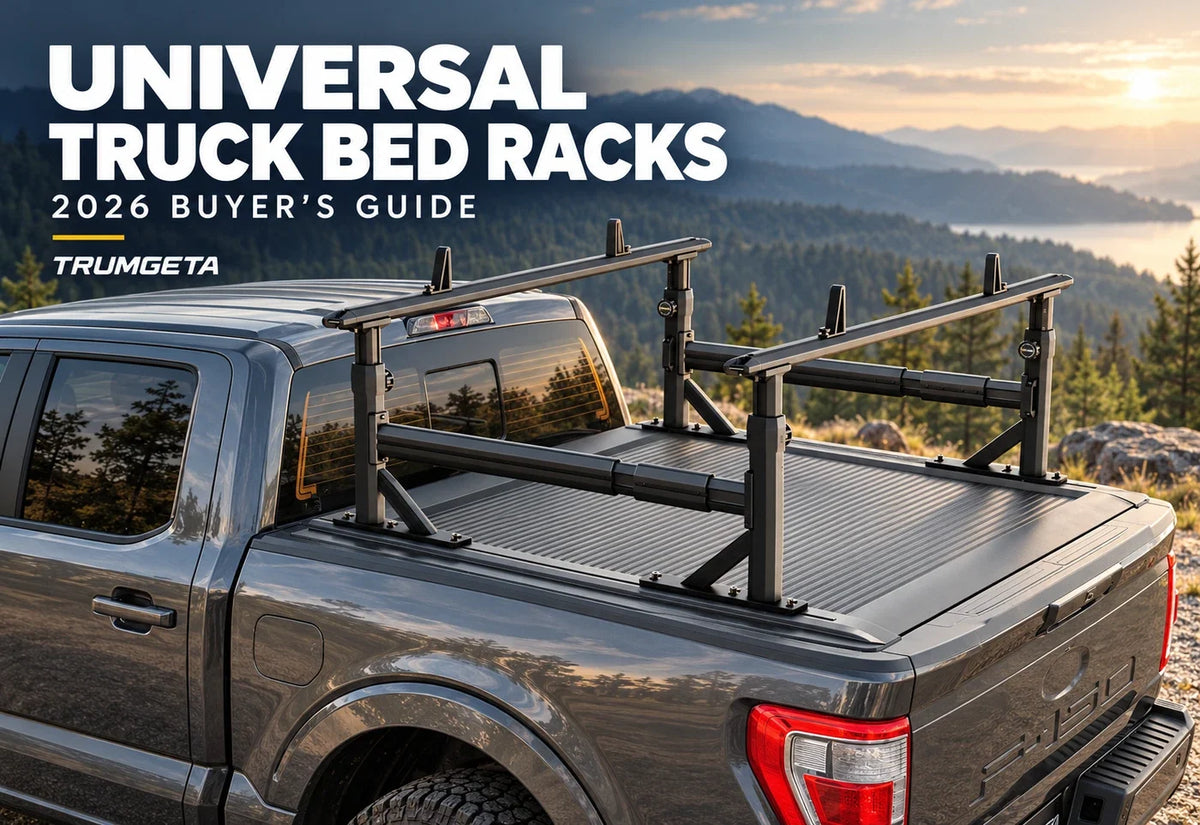
A universal truck bed rack can turn unused space above the bed into a place for ladders, kayaks, camping equipment, or a compatible rooftop tent. The difficult part is finding a system that works with the truck you actually own, especially when factory tracks, a tonneau cover, and different bed lengths enter the picture.
The best universal truck bed racks in 2026 offer useful adjustment, a mounting system suited to your bed, and clear limits for the way you carry cargo. A rack that is excellent for a covered daily driver can be the wrong purchase for an open-bed work truck.
Quick answer: Start with the mounting interface. Shortlist the TRUMGETA PRO for a compatible T-slot tonneau setup, the TRUMGETA BASE for an adjustable platform with truck-specific configurations, the Yakima OverHaul HD for adjustable height and its accessory ecosystem, the Thule Xsporter Pro Mid for a fixed mid-height layout, and the Hooke Road 18.8-inch rack for its listed full-size applications without a cover. Choose only after checking the exact year, bed, brackets, cover, and cargo requirements.
This is a TRUMGETA buyer's guide based on manufacturer product information checked on October 20, 2026. The shortlist groups options by use case. It is not a hands-on durability test or an independent performance ranking.
What Does “Universal Truck Bed Rack” Actually Mean?
Universal usually describes a rack platform that can accommodate a range of trucks through adjustment or application-specific hardware. It does not mean one box fits every pickup without changes. Crossbar width, leg spacing, and height may adjust, while the brackets still need a particular rail shape or factory track.
Think of compatibility as a chain: the truck bed supports the mounting hardware, the hardware supports the rack, and the rack supports the accessory. Every connection has to work. A crossbar that reaches across your bed cannot compensate for a clamp that has nowhere appropriate to attach.
Multi-fit systems versus vehicle-specific racks
A multi-fit design is appealing when you want adjustment or may change trucks later. A vehicle-specific rack can make sense when the bed has unusual mounting requirements or you want a tightly integrated installation. Neither approach automatically delivers better strength or value. Compare the complete, approved configuration.
Reusing a rack on your next truck may require new brackets, different bars, or a different cover interface. Treat transferability as something to verify before buying. Keeping the original hardware list and installation instructions will make that future decision much easier.
Universal Truck Bed Racks: Quick Comparison
These five options cover different mounting and cargo priorities. The table emphasizes fit and everyday usability because a larger headline capacity is useful only after the rack and truck are confirmed compatible.
On a phone, swipe the table horizontally to see all columns.
| Rack | Strongest reason to consider it | Height approach | Key fitment check |
|---|---|---|---|
| TRUMGETA PRO | Compatible T-slot tonneau installations | Four settings, 19–25 inches | Correct mid/full-size version and approved T-slot cover interface |
| TRUMGETA BASE | Adjustable work and recreation platform | Four settings, 19–25 inches | Truck-specific configuration; tri-fold covers excluded |
| Yakima OverHaul HD | Height range and accessory integration | Adjustable, 19–30 inches | Truck fit, HD Bar selection, and any track or tonneau kit |
| Thule Xsporter Pro Mid | Mid-height cargo layout | Fixed, 16 inches | Fit guide and any required Toyota/Nissan track brackets |
| Hooke Road 18.8-inch | Steel rack with side accessory panels | Fixed, 18.8 inches | Listed full-size model years; no bed rails or tonneau cover |
Height alone does not tell you whether a load will clear the cab. Measure your truck and allow for the accessory, its brackets, and the cargo itself. Adjustable height also does not guarantee that every setting carries the same approved load.
Five Universal and Multi-Fit Bed Rack Options to Consider
1. TRUMGETA PRO: For a Compatible T-Slot Tonneau Setup
The TRUMGETA PRO adjustable truck bed rack is worth a look when your cover has a compatible T-slot mounting interface. Mid-size and full-size versions are offered, with optional side bars and four height settings from 19 to 25 inches.
This layout suits owners who want cargo above the bed while retaining a suitable cover below. The key decision is the cover and rack combination. Send the cover model and photos of its rails for confirmation before ordering. The product's compatibility section excludes trucks without T-slot tonneau covers, so do not assume a bare-bed clamp installation is included.
Watch for: SKU-specific load approval. Published load figures differ across sections of the listing, so obtain the rating and installation instructions for your selected configuration before planning a heavy load or tent.

2. TRUMGETA BASE: For an Adjustable Platform With Application Choices
The TRUMGETA BASE adjustable bed rack offers an aluminum frame, T-slot accessory channels, optional side bars, and a 19–25-inch height range. Its selector provides different truck configurations, which matters more than the word “universal” in a product name or URL.
Consider it when you want to organize work gear during the week and outdoor equipment on weekends. Choose the version for your bed rather than assuming all brackets are interchangeable. The listing excludes tri-fold tonneau covers.
Watch for: The listing contains inconsistent capacity figures. Confirm the selected SKU's stationary and driving limits, mounting hardware, and any off-road or tent approval directly with TRUMGETA. Price and height adjustment should not substitute for those answers.
3. Yakima OverHaul HD: For Height Adjustment and Accessories
The Yakima OverHaul HD combines a 19–30-inch adjustment range with HD Bars, T-slots, and a removable tower system. Yakima lists a 500-pound on-road capacity and a 300-pound off-road capacity, subject to the complete installation and vehicle limits.
It is a useful shortlist option when rack height and an established accessory range drive the purchase. Check whether your order includes the bars you need. Tracked beds and supported tonneau installations require additional kits.
Watch for: Compare the price of the complete system, including vehicle adapters and cargo mounts. A tower-only price and a ready-to-install package are different purchases. Confirm the fit guide for the exact truck and cover combination.
4. Thule Xsporter Pro Mid: For a Fixed Mid-Height Layout
The Thule Xsporter Pro Mid, model 500011, uses a fixed 16-inch height, aluminum construction, T-track channels, and adjustable load stops. Thule describes fit for many compact and full-size pickups. Certain Toyota and Nissan bed-track applications need separately sold brackets.
This layout is worth considering when reaching the cargo matters more than raising long items above the cab. Thule lists a maximum load of 600 pounds with proper installation and even distribution. That figure does not by itself establish an off-road or occupied-tent rating.
Watch for: A fixed height needs careful measurement. Check cab clearance, tent mounting dimensions if applicable, and whether the cargo can extend forward without contact.
5. Hooke Road 18.8-Inch Rack: For Listed Full-Size Trucks With an Open Bed
The Hooke Road 18.8-inch overland rack, HE.9906-S, uses steel construction, adjustable width and length, and side panels for mounting accessories. It is an application-limited option rather than an all-truck solution.
The published fitment covers specified model years of the Ford F-150/Raptor, Ram 1500, Silverado 1500, and Sierra 1500 without bed rails. The listing excludes tonneau covers and gives an approximate product weight of 126 pounds.
Watch for: Confirm your year against the current fitment list. Consider the rack's own weight in your truck setup and check whether its fixed height and side panels suit your loading routine. This is not the covered-bed option in the shortlist.
The Fitment Checklist: Measure Before You Order
1. Record the exact truck and bed
Write down the year, make, model, bed length, and factory bed equipment. Include any utility tracks, rail caps, storage compartments, or modifications near the proposed mounting points. A truck's trim name alone may not describe the bed interface accurately enough.
Take clear photographs from above and below each rail. A seller can often resolve a bracket question faster from those photos than from a message saying “standard bed.” Keep the confirmation tied to a specific SKU and hardware kit.
2. Measure the mounting span and available length
Measure between the surfaces the rack will actually mount to. The distance between inner bed walls, the outside of the rail caps, and the centers of cover tracks can all differ. Use the dimension requested in the installation drawing.
Then check usable front-to-rear space. A cover canister, angled bed wall, or hardware near the tailgate can reduce the length available for the rack's feet. Confirm that the intended mounting positions also provide the crossbar spacing required by your cargo accessory.
3. Identify the mounting method
Common approaches include clamps beneath the bed rail, brackets in factory utility tracks, and hardware attached to an approved tonneau T-slot. These interfaces solve different problems. Accessory T-slots on the top of a crossbar do not prove the rack can mount to a cover's rails.
For a no-drill installation, check how the bracket reaches the specified structural surface and whether existing bed protection interferes. Follow the manufacturer's instructions for liners and rail caps. Do not improvise spacers or trim truck parts to force an unapproved fit.
4. Check the cover through its full movement
A cover may fit beneath a rack when closed yet collide with an upright as it folds or rolls. Consider latch access, the first folding panel, the stored bundle of a roll-up cover, and the canister of a retractable system. Side bars can also affect access.
Ask whether you will retain the cover's full opening function after installation. For a daily driver, being able to reach a cooler or unload a toolbox can matter more than adding another accessory mount. Request confirmation for the actual rack-and-cover pairing.
5. Mock up the installed height
Use the bed rail as the starting point and compare the rack's top surface with the cab, garage opening, and intended cargo position. Include the height of any tent or carrier above the bars. Record the finished vehicle height where you can check it before entering a garage.
If you carry long items forward over the cab, measure that path specifically. If everything stays behind the cab, a lower setup may be easier to load. Choose the lowest approved position that gives the clearance and cargo access your use requires.
How to Compare Load Ratings Without Getting Misled
Read the conditions attached to a capacity. A static rating concerns a stationary setup. An on-road or dynamic rating concerns travel under specified conditions. An off-road rating may be lower because the rack sees different forces. Manufacturers do not always use these labels identically.
A useful comparison needs the same operating condition, installed configuration, and load-distribution requirement. If one listing gives an on-road number and another gives a stationary number, the larger figure does not establish the stronger driving setup. Obtain the missing information before deciding.
Check the complete load path
The bed, mounting rails, adapters, rack, and cargo carrier all have limits. Adding a stronger rack cannot increase the vehicle manufacturer's payload or axle ratings. Passengers, bed cargo, the rack itself, and accessories still contribute to the truck's loaded weight.
Use the applicable vehicle labels and the rack and accessory manuals to plan the load. When the approved combination is unclear, have the manufacturer confirm it. Do not estimate a missing capacity from the appearance of a bracket or the thickness of a crossbar.
Rooftop tents need an additional check
A tent installation requires suitable crossbar shape, spacing, mounting plates, and clearance. Confirm that the rack manufacturer approves your application, including the relevant stationary load when people occupy the tent. Also check the tent manufacturer's requirements for supporting bars.
Plan for both travel and camp. During travel, include the tent and equipment that remain on the rack. At camp, use the stationary limits and installation conditions for the complete system. A photograph of a tent on a similar truck is not a substitute for those instructions.
Budget for the Complete Setup and Everyday Ownership
Compare installed cost
Build a short shopping list before comparing prices: rack, crossbars if separate, truck adapters, cover adapters, cargo mounts, locks, and installation supplies specified by the manufacturer. Add any delivery or installation charges that apply. This gives you a useful total rather than an attractive starting price.
A cheaper rack can work out well when its supplied hardware matches your truck and you need few accessories. A more expensive platform can be worthwhile when its adjustment and mounting options solve a specific need. Choose based on the complete setup you will use.
Choose materials with the loading routine in mind
Material is only one part of a rack's design. Compare the actual assembled weight, joint construction, finish, replaceable parts, and installation requirements. If you remove the rack regularly, handling and storage deserve as much attention as how the rack looks on the truck.
Inspect coating damage and hardware during normal maintenance, and follow the maker's cleaning and corrosion-care instructions. Ask about spare brackets before purchase if the rack may move between vehicles. Keeping a usable system often depends on small replacement parts.
Make the installation repeatable
Lay out the supplied parts and compare them with the manual before assembling. Follow the specified alignment and tightening sequence. Use the listed torque values and any required recheck interval. Save the instructions and photographs of the finished mounting points for later inspections.
For a removable system, find out which pieces stay on the truck and where the rack will be stored. Think through whether one person can handle the components as instructed. A setup that is awkward to remove may stay installed even when you need the bed open.
Keep cargo access practical
Imagine loading the heaviest item you use regularly, reaching equipment near the cab, and opening the tailgate with the truck parked close to a wall. Check whether side accessories obstruct that routine. Keep necessary tools and tie-down points accessible after the rest of the gear is loaded.
Use appropriate cargo mounts and securement for each item according to the relevant instructions. Crossbars create support points, but they do not secure cargo by themselves. Plan the mounting method at the same time as the rack purchase.
Which Bed Rack Setup Fits Your Truck Life?
Daily driver with a tonneau cover
Start with the cover manufacturer, model, and mounting interface. A supported T-slot setup may make the TRUMGETA PRO worth investigating. Verify cover operation, final height, and access to everyday cargo. Having a cover you can still use comfortably should be part of the purchase criteria.
Work truck carrying ladders or long materials
Focus on cab clearance, cargo support spacing, load stops, and the approved driving load. Compare adjustable platforms and measure the entire load path before choosing a height. Include the tools and passengers already in the truck when checking the overall vehicle loading.
Weekend kayak or camping setup
Consider how high you can comfortably load the equipment and which carrier attaches correctly to the bars. You may value a removable system or a lower cargo position more than extra side panels. Leave space to reach the camping equipment stored in the bed.
Overland truck with a rooftop tent
Start with the tent's mounting requirements and the rack manufacturer's approval for the intended use. Then check the travel load, occupied stationary setup, and access to the bed. Add side-mounted gear only after confirming the complete configuration remains within its limits.
A fast buying rule: Eliminate anything with an unconfirmed mounting interface first. Compare the remaining options by cargo dimensions, approved load conditions, cover operation, installed height, and complete cost. Appearance becomes a much easier decision after those questions are settled.
Ready to narrow the shortlist? Browse TRUMGETA truck bed racks and ladder racks, then contact TRUMGETA with your truck year, model, bed length, factory track details, and tonneau cover model. Ask for the exact SKU, mounting kit, and applicable load instructions before ordering.
Frequently Asked Questions
Do universal truck bed racks fit every pickup?
No. Universal generally means a rack can fit a range of applications through adjustment or different hardware. The truck year, bed length, rail shape, factory tracks, and any tonneau cover still determine whether a particular installation is approved.
What is the best universal truck bed rack in 2026?
The best choice depends on the bed interface and cargo. Start with an approved fit, then compare height, cover operation, complete cost, and the limits for your intended use. The five options above serve different configurations, so there is no single winner for every truck.
Can I use a truck bed rack with a tonneau cover?
Sometimes. The rack and cover need a compatible mounting interface and enough clearance for the cover to function. A T-slot cover installation and a clamp-on bare-bed installation use different hardware. Confirm the exact pairing rather than relying on a general tonneau-compatible label.
Is an adjustable bed rack better than a fixed-height rack?
Adjustment helps when cargo dimensions or clearance needs change. A fixed-height rack can work well when its installed position suits your regular load. Measure the cab, cargo, and garage first, and confirm the approved settings for the configuration you plan to use.
Can a universal truck bed rack support a rooftop tent?
Only when the rack, mounts, bed interface, and tent are approved for that application. Check travel limits, stationary occupancy conditions, crossbar spacing, and attachment dimensions. Do not use a static rating alone to decide what can be carried while driving.
Does a higher rack load rating increase truck payload?
No. The truck's own ratings still apply. Include the rack, accessories, passengers, and all cargo when evaluating the loaded vehicle. The mounting system and cargo carrier also retain their own limits, even if the rack has a higher advertised capacity.
Are no-drill bed racks easy to transfer to another truck?
They may be transferable, but adjustment does not guarantee fit on a second vehicle. Confirm the next truck's bed dimensions and mounting interface. New brackets, crossbars, or adapters may be necessary, and the manufacturer should approve the complete installation.
What should I send a seller to confirm rack fitment?
Send the year, make, model, bed length, factory track details, and cover manufacturer and model. Include photos above and below the rails and describe the intended cargo. Request written confirmation of the exact rack SKU, required hardware, and applicable instructions.
Manufacturer References
Fitment and product details were checked against the linked TRUMGETA, Yakima, Thule, and Hooke Road listings above on October 20, 2026. Product configurations, availability, and specifications can change. Use the current application instructions for the exact parts you order.

Leave a comment
This site is protected by hCaptcha and the hCaptcha Privacy Policy and Terms of Service apply.