
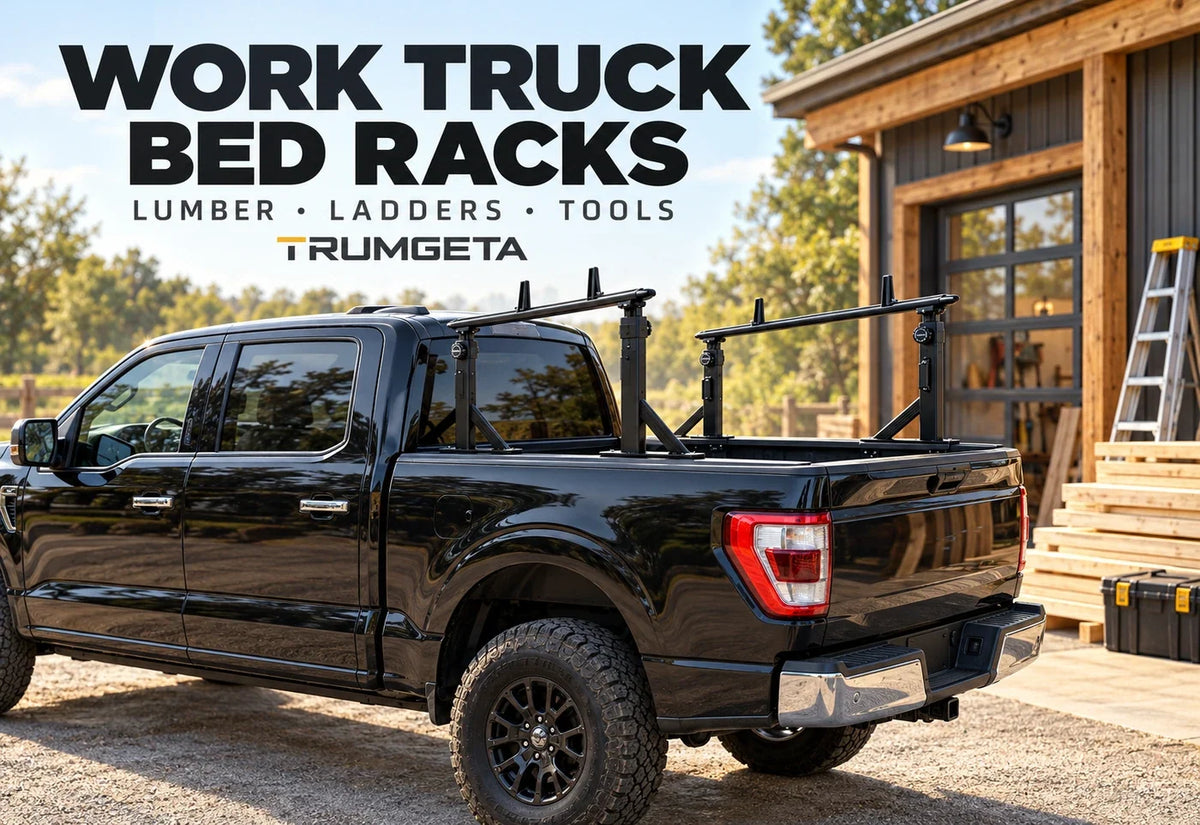
The best truck bed racks for lumber, ladders and tools make the workday easier in three ways: they support long cargo above the bed, provide suitable attachment points, and leave room to reach the equipment below. The right choice depends on what you carry most often and how the truck is already equipped.
A two-bar rack can be useful for occasional materials runs. A sliding system can accommodate a changing load layout. A larger contractor-style frame can suit frequent ladder and material hauling. None of those designs automatically solves toolbox clearance, cab clearance, or the truck's own load limits.
Quick answer: Compare Thule TracRac SR for movable rack positions, WEATHER GUARD 1275-52-02 for a contractor-style steel frame, Yakima OverHaul HD for adjustable height, and AA-Racks APX25 for a straightforward aluminum setup. TRUMGETA PRO C1570 is another adjustable candidate, subject to confirmation of its conflicting fit and load information.
This TRUMGETA guide uses manufacturer information checked on October 25, 2026. The selections address different work requirements and are not based on independent load testing or a universal strength ranking.
Compare Truck Bed Racks for Work Cargo
Start with the arrangement you need, then check the exact model's documentation. The published numbers below use the manufacturer's own categories. A maximum distributed load should not be treated as a point-load, off-road, or stationary-use rating unless the instructions say so.
On a phone, swipe the table horizontally.
| System | Main advantage to investigate | Published load description | Confirm before buying |
|---|---|---|---|
| Thule TracRac SR | Sliding rack positions along base rails | Up to 1,250 lb, with proper installation and even distribution | Vehicle-specific rails, components, and cargo support |
| WEATHER GUARD 1275-52-02 | Contractor-style steel frame and tie-down locations | 1,000 lb evenly distributed | Truck fit, mounting space, and toolbox layout |
| Yakima OverHaul HD | Adjustable 19–30-inch crossbar height | 500 lb on-road; 300 lb off-road | Bars, truck adapters, and needed clearance |
| AA-Racks APX25 | Two-bar aluminum utility layout | Up to 800 lb distributed utility load | Full-size fit; utility-track exclusion |
| TRUMGETA PRO C1570 | Height adjustment and crossbar T-slots | Current fit and load descriptions require clarification | Exact SKU, truck interface, and current instructions |
Five Rack Systems to Investigate
Thule TracRac SR: For Changing Cargo Positions
The Thule TracRac SR uses sliding rack assemblies on base rails. Its aluminum construction, adjustable load stops, and ARC cleats provide a work-oriented system for supporting and attaching different cargo.
Thule lists a maximum of 1,250 pounds when the system is properly installed and the load is evenly distributed, with vehicle limits still applying. That is not permission to put the entire amount on one crossbar or use an unsupported extension.
Useful for: Owners whose material lengths and bed access needs change regularly. Check first: The correct truck-specific base rails, overhead components, toolbox interfaces, and any separate cantilever accessory. Repositioning the rack must follow the instructions and preserve the support required by the load.
WEATHER GUARD 1275-52-02: For a Dedicated Contractor Layout
The WEATHER GUARD 1275-52-02 is a full-size steel truck rack with adjustable front legs, stake-pocket and clamp mounting, and a manufacturer-listed 1,000-pound evenly distributed capacity.
The design includes tie-down locations and a removable rear cross member for loading larger items. Those features make it worth considering when the truck spends most days carrying work materials rather than switching between an empty bed and a weekend setup.
Useful for: A dedicated material-hauling truck with an appropriate mounting arrangement. Check first: Vehicle fit, toolbox compatibility, and the installed configuration required for travel. Removing a cross member for access does not establish that the rack can carry its normal load with that member absent.
Yakima OverHaul HD: For Adjustable Working Height
The Yakima OverHaul HD offers 19–30-inch height adjustment, HD Bars, attachment channels, and a QuickChange arrangement for removal. Yakima publishes 500 pounds on-road and 300 pounds off-road for the approved system.
Height adjustment is useful when you need different clearances for different tasks. It does not guarantee that a particular setting clears your cab, toolbox, or material bundle. Measure those relationships with the actual truck and equipment.
Useful for: Mixed work and personal use where adjustable clearance and removal matter. Check first: Bar size, bed attachment, required adapters, and the manufacturer's assembly and use instructions. Include all required components when comparing the finished setup.
AA-Racks APX25: For a Straightforward Aluminum Two-Bar Setup
The AA-Racks APX25 listing describes aluminum construction, no-drill mounting clamps, and distributed utility loads up to 800 pounds. Its stated dimensions are 71 inches wide and 28 inches high.
The important fit limitation is explicit: this model is not compatible with trucks using utility track systems. AA Products also lists load-stop and window-guard accessories separately, so check what is included in the chosen package.
Useful for: Owners comparing a relatively simple two-bar utility arrangement. Check first: Exact full-size truck application, clamping clearance, and accessory requirements. APX25, APX25-Lite, and other similarly named products are different models; do not transfer dimensions or limits between them.
TRUMGETA PRO C1570: An Adjustable Option Requiring Exact Confirmation
The TRUMGETA PRO C1570 product description lists an aluminum structure, 70.9-inch crossbars, four height settings from 19–25 inches, and T-slot channels.
However, the listing's vehicle sections disagree about bed-rail requirements, and the main image's static/dynamic labels do not match the description's on-road/off-road labels. This guide therefore does not assign C1570 a definite capacity or approve a truck application.
Useful for: Owners investigating an adjustable two-bar configuration. Check first: Ask TRUMGETA to confirm the exact SKU, truck and rail arrangement, required hardware, and applicable load instructions before ordering.

Choose Around the Cargo You Carry Most Often
Occasional lumber runs
If your truck normally carries ordinary bed cargo and only sometimes brings home long materials, removal and storage can matter as much as capacity. Consider whether the rack can come off without disturbing your regular bed setup and whether you have a suitable place to keep it.
Measure the materials you commonly purchase rather than selecting a rack around the longest item you might carry once. If a particular load cannot be supported and secured within the approved arrangement, plan another transport method for that job.
A ladder carried every working day
For a daily ladder, evaluate the entire loading routine. Can you reach the support points, position the ladder without contacting the truck, and apply the required restraints? Can you remove it without unloading tools underneath?
Different ladders have different transport requirements. Follow the ladder manufacturer's guidance for support and restraint as well as the rack instructions. Do not assume a roof or bed-rack photograph establishes a suitable arrangement for your ladder.
Materials and tools on the same trip
A rack creates a second carrying level, but it does not separate the planning problems. A material bundle above the bed can block a toolbox lid or prevent a large case from being lifted out.
Walk through a normal stop: park, retrieve the first tool, unload the material, and reload the equipment. The rack that allows that sequence without unnecessary rearranging may be a better purchase than a larger system that constantly obstructs it.
Sheet goods need a separate support plan
If your materials list includes plywood or other large panels, discuss that load explicitly. A rack arrangement suitable for a narrow ladder does not automatically provide the support a broad sheet requires. Check the panel's support needs, permitted orientation, and the manufacturer's approved transport arrangement.
Do not treat two crossbars as a continuous cargo deck or assume a bundle of narrow boards will support a panel placed above it. If the complete sheet load cannot be supported and restrained as instructed, use a transport arrangement intended for it. This is a different question from whether the rack's total weight rating looks sufficient.
Measure Support Spacing, Cab Clearance, and Loading Space
Crossbar length is not cargo support length
The crossbar runs across the truck. The distance between the front and rear supports runs along it. Both dimensions matter, but they solve different problems. A wide crossbar does not provide extra support along a long board or ladder.
Use the cargo manufacturer's requirements and the rack's permitted bar positions to establish the support arrangement. Keep the intended contact surfaces on the supports. A ladder foot, protruding hinge, or uneven bundle may prevent the load from resting as expected.
Confirm clearance above the cab
A rack can stand above the bed rails yet still sit too low for a long load to extend over the cab. Measure from the actual cargo-bearing surface to the highest relevant part of the vehicle. Account for the load's shape and the clearances required by the instructions.
Do not rest material directly on the cab to compensate for insufficient rack height. If you need forward support, investigate a manufacturer-approved extension or a different rack configuration. Adding an improvised roof contact changes the support arrangement.
Check width and overhang as a complete layout
Measure the cargo, the installed load stops, and anything projecting beyond the support surfaces. A nominal crossbar width is not necessarily the usable width remaining between stops or accessories.
Plan the full loaded vehicle envelope, including both ends of long cargo. Check the route, parking area, loading location, and applicable local requirements before departure. There is no single maximum material length that can be inferred from a rack's weight rating.
Leave room to load and unload
Consider where you will stand, how the cargo reaches the rack, and whether the surroundings allow that movement. A garage ceiling, wall, or other vehicle can block a loading path that looked straightforward in an open parking lot.
For items you cannot handle comfortably within the approved procedure, arrange appropriate assistance or another loading method. The rack's load capacity says nothing about whether a person can safely lift that amount onto it.
Check Rack Load and Vehicle Load Separately
Build a realistic material list
Write down the actual load, including cargo attachments and any equipment remaining on the rack. Material dimensions alone are not a reliable substitute for weight. Different products, quantities, and moisture conditions can change the weight of a lumber order.
For a hypothetical planning example, 180 pounds of boards, a 45-pound ladder, and 15 pounds of rack-mounted accessories total 240 pounds. These are invented worksheet inputs, not product specifications or approval for any rack. Replace them with your actual information.
Apply the relevant operating category
Match the total with the manufacturer's applicable category and installation requirements. A distributed maximum does not mean the same weight can be concentrated at one end. A parked number does not establish a traveling limit.
Also check the limits of individual bars, brackets, adapters, and accessories where specified. If the listing leaves a necessary condition unclear, request the current instructions. Do not create an off-road number by subtracting a percentage from an unrelated maximum.
The truck carries everything, including the rack
The vehicle's trip load includes the rack, occupants, materials, tools, and other equipment. Follow the truck manufacturer's load information and applicable axle and tire limits. Installing a rack does not increase the vehicle's allowed load.
In a second hypothetical worksheet, a 55-pound rack, 350 pounds of occupants, 180 pounds of tools, and the 240-pound rack load total 825 pounds added to the truck. This arithmetic illustrates why a rack-only calculation is incomplete; it does not determine a particular truck's remaining capacity.
Keep Tools Secure and Toolboxes Usable
A bed rack is not a tool-storage system
A rack can free space below long cargo, but loose tools still need suitable storage and restraint. Decide where closed cases, small parts, batteries, and frequently used equipment will travel. Use containers and attachments intended for the equipment and vehicle.
Do not assume that a hard case is secured simply because it fits tightly between other items. Changes in the load can remove that restraint. Plan each storage component as part of the traveling arrangement.
Measure toolbox lid movement
For a crossover toolbox, check the mounting footprint along both bed rails and the complete lid arc. Uprights, clamps, sliding rails, and a material bundle can each interfere with opening. Check access to locks and handles as well.
If the rack manufacturer offers a toolbox mounting kit, verify that it supports your box and exact rack arrangement. A separate adapter may solve one interference while leaving another. The toolbox should remain serviceable after all the cargo is installed.
Consider covers and removable equipment
Some rack configurations work with selected tonneau covers. Confirm the exact pairing, then distinguish between the cover closing beneath the rack and being able to open fully. A folded cover or rolled bundle can occupy space needed by an upright or toolbox.
Removable bars can help when carrying bulky bed cargo, provided removal and reinstallation follow the instructions. Keep the parts together and verify the installation again before loading. Quick removal should not become a reason to skip the attachment checks.
Confirm the Truck Interface and Complete Purchase
Prepare the truck's year, make, model, bed length, rail system, liner details, and existing accessories. Photograph the underside and top of the bed rails where the rack will attach. Broad labels such as “full-size” leave important differences unresolved.
Ask whether the attachment uses a stake pocket, a clamp beneath the rail, or a factory track. Check required adapters and any conflicts with trim, storage boxes, or a cover. A no-drill installation still needs suitable mounting surfaces and the correct hardware.
Compare complete configurations: towers or frame, crossbars, base rails, vehicle adapters, load stops, tie-down accessories, toolbox kits, and approved extensions. An inexpensive base listing can require additional components before it matches your workflow.
Allow for the rack's installed weight and the work involved in changing configurations. For TRUMGETA C1570, obtain consistent fit and load documentation first. Combining a compatibility statement from one variant with a favorable capacity from another does not establish an approved system.
Plan Cargo Securement and Inspection Before the First Trip
Load stops and tie-downs do different jobs
Load stops can help position cargo laterally, but they are not a complete restraint system. Use suitable restraints and approved attachment locations according to the cargo, rack, and restraint manufacturers' instructions. An accessory channel is not automatically a rated anchor for every fitting.
Look at the contact points and strap paths before loading. Keep restraints away from damaging edges where the instructions require protection, and make sure the cargo arrangement allows inspection. Do not assume a single restraint will manage every direction of movement.
Inspect the installation and the load
Use the specified fasteners and tightening guidance; there is no universal torque setting for different racks and clamps. Follow the prescribed checks after installation and during use. Recheck when the cargo or rack position changes.
Before departure, inspect mounting points, restraints, and the condition of the load. Follow the required travel checks, and address movement or damage before continuing. Keep the relevant instructions available rather than relying on memory from the original installation.
Plan the unloaded return trip
After unloading, inspect what remains on the truck. Remove or secure unused restraints as their instructions require, and check that adjustable stops or removable components are still retained correctly. A different return load needs its own support and restraint check.
If the day ends with an empty bed, keep the hardware needed for the next installation organized and identifiable. Photographing the working configuration can help you restore the intended arrangement, but it does not replace checking the components when they are reinstalled.
Planning a TRUMGETA work-truck setup? Browse TRUMGETA bed racks and ladder racks, then send your truck, bed-rail, toolbox, and cargo details to confirm the exact application and required components.
Frequently Asked Questions
What is the best truck bed rack for lumber?
The best match supports the actual material at suitable locations, clears the vehicle, and provides an approved way to restrain it. Choose the rack around common material lengths, weight, and loading routine. A weight rating alone does not establish the longest board it can carry.
Can a ladder rack carry lumber and tools together?
It can be part of that arrangement if the rack, vehicle, cargo, and storage limits are met. Long materials may travel above the bed while tools remain in suitable secured storage below. Check access, total vehicle load, and interference between the two levels.
Do I need a sliding rack or an adjustable-height rack?
Sliding supports change their positions along the bed; height adjustment changes clearance above it. These are different capabilities. Decide whether your main problem is support spacing, space for cargo removal, cab clearance, or a combination before choosing a design.
Are load stops enough to secure a ladder?
No. Stops help locate the load but do not replace a suitable restraint arrangement. Follow the ladder, rack, and restraint manufacturers' instructions for support, attachment points, and travel checks. Confirm that any accessory fitting is appropriate for the intended use.
Will a bed rack work with my crossover toolbox?
That depends on the rack's mounting footprint, the box's attachment, and the lid movement. Measure all three and check any required toolbox adapter. Verify access with the intended cargo on the rack, since a bundle above the bed can obstruct an otherwise clear lid.
Does a higher rack capacity increase my truck's payload?
No. The vehicle's limits still apply, and the rack itself adds weight. Count occupants, tools, materials, attachments, and other equipment in the complete vehicle load. Follow the truck manufacturer's load information as well as the rack's conditions.
Can any no-drill rack fit a truck with factory bed tracks?
No. A clamp-on, stake-pocket, or track-mounted system requires the appropriate interface. Some racks explicitly exclude utility tracks, while others need application-specific adapters. Confirm the exact truck and hardware instead of treating no-drill as universal fit.
What should I do if a product page gives conflicting specifications?
Save the exact SKU and conflicting information, then request current documentation for your truck and intended load. Wait for a consistent answer before relying on a capacity or fit claim. Do not choose the largest number or mix specifications from similar variants.

Leave a comment
This site is protected by hCaptcha and the hCaptcha Privacy Policy and Terms of Service apply.