
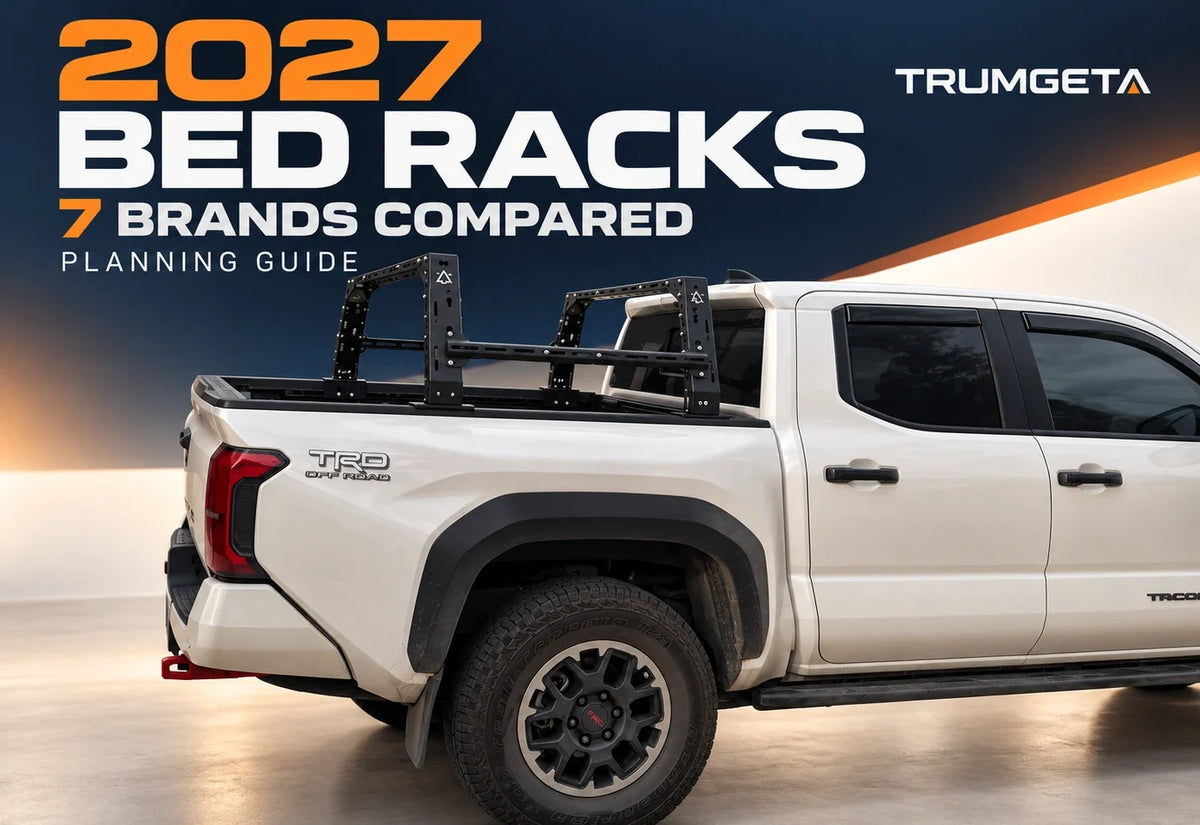
Planning a truck bed rack purchase for 2027 starts with the truck, cargo, and bed setup you expect to use. The best truck bed rack brands offer different kinds of systems: adjustable bars, work-oriented racks, cover-compatible arrangements, and modular frames with dedicated storage or accessory mounts.
This 2027 planning guide compares seven brands through examples from their currently published product information. Specifications were checked on October 28, 2026. Confirm later revisions and the exact vehicle application before ordering, especially when buying a 2027-model-year truck.
Quick answer: Compare TRUMGETA for its selected truck and rail variants, Yakima for adjustable bar systems, Leitner for integrated storage options, Küat for configurable frames, Thule for work-oriented carrying systems, ADARAC for cover-focused layouts, and Putco for modular accessory channels. Select the complete supported configuration that matches your use.
Selections are based on manufacturer documentation and practical configuration differences. This guide does not claim independent testing of a 2027 product range, future-release knowledge, or a universal durability ranking.
Top Truck Bed Rack Brands to Compare for 2027
The examples below identify a starting point within each brand. Features belong to the named system and selected application. A brand can sell several rack families with different mounting methods, accessories, and operating limits.
On a phone, swipe the table horizontally.
| Brand and example | Design feature to investigate | Useful purchase question | Important qualification |
|---|---|---|---|
| TRUMGETA — C1902 family | Adjustable frame with separate truck/rail variants | Which exact SKU matches my bed? | Platform excluded; construction and route conditions need confirmation |
| Yakima — OverHaul HD | Height-adjustable HD Bar system | Which bars and adapters complete the installation? | Base-system limits do not automatically cover every adapted combination |
| Leitner — standard ACS FORGED | Optional GearPOD storage and sliding load bar | Will storage and upper cargo preserve access? | Standard, no-drill, and tonneau versions differ |
| Küat — IBEX | Full- and mid-height configurations | Does the route fall within the user guide? | Explicit terrain restrictions apply |
| Thule — TracRac Pro 2 | Aluminum work rack with load stops and toolbox interfaces | Does the exact truck and toolbox combination fit? | Maximum load retains installation and distribution conditions |
| ADARAC — Aluminum Pro Series | Vertical uprights and cover-oriented utility rails | Can the cover operate with my equipment installed? | Vehicle reinforcement or drilling may be required |
| Putco — Venture TEC | TEC channels and optional mounting accessories | Which top rails and mounts are included? | Cover compatibility varies by application |
Current System Examples From Seven Brands
TRUMGETA: Start With the Exact Truck and Rail Variant
The TRUMGETA C1902 family separates selected full-size trucks without rails from Tacoma/Gladiator applications with bed rails. The page lists three height settings, 300 pounds dynamic, and 600 pounds static. The platform is not included.
This is a useful example of why the variant matters. Confirm the truck, cover interface, upper equipment support, and route conditions. The description says steel or aluminum alloy without identifying one definite material, so request the exact variant's construction information.
Compare it for: An adjustable arrangement that matches a published truck/rail group. Confirm the chosen SKU and current instructions before treating it as a supported installation.
Yakima: Compare the Bars, Towers, and Adapters Together
The Yakima OverHaul HD combines HD Bars with 19–30-inch height adjustment and a QuickChange attachment arrangement. Its base-system listing publishes 500 pounds on-road and 300 pounds off-road.
The practical buying question is which components complete your truck's setup. Bar size, factory tracks, and a retained cover can change the required hardware. Check each component's instructions and limits.
Compare it for: Changing clearance needs or a truck that alternates between different uses. Measure the loaded arrangement and verify the full installation instead of assuming a base listing includes every adapter or approves every combination.
Leitner: Compare Storage Access as Part of the System
The standard Leitner ACS FORGED Ford example describes a 23-inch frame, a sliding load bar, accessory rails, and optional locking GearPOD storage.
Dedicated storage can be an important distinction when the same equipment needs to be reached frequently. Check lid access, upper cargo, and the parts required for the intended layout. Optional storage should be included in the configuration and load plan.
Compare it for: A build organized around accessible equipment storage. Keep the standard rack, no-drill version, and tonneau versions separate; their features and installation details should not be transferred between listings.
Küat: Compare Frame Configuration and Permitted Conditions
The Küat IBEX offers full- and mid-height configurations and two crossbars. The current product page and official user guide specify 300 pounds dynamic and 1,200 pounds static.
The guide excludes rock crawling, jumping, bogging, high-speed off-road driving, and terrain requiring aftermarket 4WD suspension upgrades. Those restrictions remain relevant when comparing its configuration options.
Compare it for: A configurable frame whose intended route and equipment fall within the instructions. An adventure-oriented appearance or a large static figure does not establish unrestricted trail use.
Thule: Compare the Specific Work-Rack Model
The full-size Thule TracRac Pro 2, model 37002XT, uses aluminum crossbars, corner braces, adjustable load stops, ARC cleats, and toolbox interfaces.
Thule lists up to 1,000 pounds with proper installation and even weight distribution, subject to vehicle limits. That figure does not establish a point-load allowance or compatibility with any toolbox.
Compare it for: Work materials and equipment carried on a supported pickup installation. Check the selected vehicle and complete package; another Thule rack family can use different hardware and features.
ADARAC: Compare Cover Operation and Vehicle Requirements
The ADARAC Aluminum Pro Series uses vertical uprights and utility rails. Its published categories are 500 pounds dynamic, 400 pounds off-road dynamic, and 1,000 pounds static, evenly distributed.
The cover-oriented design makes exact cover pairing important. The installation instructions also identify vehicle reinforcement requirements for some applications. The manufacturer states that trucks without stake pockets require drilling.
Compare it for: A truck retaining a supported inside-the-rail cover. Verify opening movement, mounting requirements, and the complete accessory load rather than interpreting general no-drill or cover-compatible language as universal.
Putco: Compare the Accessory Layout and Included Components
The Putco Venture TEC uses 6061-T6 aluminum and TEC channels, with optional top cross rails and side mounting accessories.
Clarify the upper support components needed for your equipment. The current listing identifies top rails and several kits as separate options. A product photo is not a complete bill of materials.
Compare it for: A vehicle-specific modular arrangement. Confirm the exact application and cover interface: the current page explicitly says the Tacoma version does not work with a tonneau. A broader family-level compatibility statement does not override that restriction.

What to Confirm Before a 2027 Purchase
Keep the guide year separate from vehicle fit
A 2027 buying guide is a planning resource. Vehicle compatibility depends on the manufacturer's actual application information for the truck you will use. A familiar model name does not establish that its bed rails, factory equipment, or mounting requirements are unchanged.
Record the model year, bed length, factory tracks, liner, and cover details. If your intended truck is not listed, obtain confirmation for the exact rack and hardware before ordering. Avoid assuming that an earlier-year fit automatically continues.
Check the current revision when you order
Product packages, adapters, instructions, and availability can change after a guide is prepared. Save the relevant listing, SKU, and current instructions with the order. Check whether any component in the planned configuration has been revised.
Use the latest applicable manufacturer information to resolve a discrepancy. A dealer summary, old brochure, or previous product-family name can help locate a system, but the final decision needs the correct current application.
Make the comparison transparent
Define what matters for your use: cargo support, cover operation, adjustable height, storage, or removal. A useful shortlist can prioritize those requirements without inventing a universal strength score or a promised service life.
Read testing claims in context. Identify the named model, configuration, method, and conditions before treating a claim as relevant to your setup. Manufacturer information for one product cannot establish how every rack from that brand performs.
Choose the Design Around the Cargo
Work materials, camping equipment, bikes, and other supported cargo can need different layouts. Start with the equipment you actually expect to carry and the support positions it requires. A tall frame is not automatically more useful than bars at a suitable lower height.
Measure the space needed to open containers, lift items from the bed, and inspect attachments. Check both the stored position and the movement. A cargo case can fit between uprights yet need extra room for its lid.
For long items, crossbar width and front-to-rear support spacing are separate dimensions. Check support and restraint requirements with the cargo and rack instructions. Measure cab clearance from the actual cargo-bearing surface.
For a tent, confirm bar or platform dimensions, clamp geometry, and the occupied setup separately. A rack's static rating does not establish that every tent can mount to it. For other accessories, check the receiving rail or panel and the bracket's permitted load and orientation.
Also decide whether the rack stays installed between uses. Removable components need suitable storage and a clear reinstallation procedure. Adjustable components should remain accessible when the full equipment layout is fitted.
Compare the Bed Interface and Cover as One Installation
Identify whether the rack uses factory tracks, stake pockets, clamps beneath the rail, or a cover's supported channels. Similar-looking attachment points do not make mounting hardware interchangeable.
Check a tonneau combination in three stages: rack attachment, cover closing, and cover opening. A folding panel, rolled cover, or retracting section can occupy space needed by an upright or storage container.
Use the exact cover make and model when asking about fit. Include photographs of the rails and existing accessories if the manufacturer requests them. Retaining a cover should be confirmed with the rack and cover requirements together.
Keep reinforcement and modification requirements visible in the purchase decision. No-drill wording may apply to a particular interface. The installation for a truck without that interface can be different.
Where source statements conflict, identify the SKU and specific truck application. Putco's current Tacoma restriction illustrates why a general cover claim should be narrowed to the actual installation. Record the confirmed answer instead of combining favorable statements from different versions.
Read Load Ratings With the Same Questions
Compare the operating condition
Static, general dynamic, on-road, and off-road dynamic are different categories. Preserve the manufacturer's definitions and restrictions. A missing category should be clarified rather than estimated from another number.
Check distribution requirements as well as the total. A maximum spread across the system does not establish that one crossbar, attachment, or side panel may carry the same amount. Confirm how adapters and accessory positions affect the approved configuration.
List the actual equipment
A hypothetical worksheet might include a 150-pound tent, 15 pounds of mounts, 25 pounds of side equipment and brackets, and a 30-pound cargo item: 220 pounds carried by the rack. These are example inputs, not product specifications or approval for any system.
Use actual weights for your setup and compare the complete arrangement with the applicable instructions. Side-accessory limits should not be treated as separate allowances that can automatically be added to the main rating.
Check the vehicle separately
The truck carries the rack itself, occupants, cargo, storage, and other added equipment. Follow the vehicle's load information and applicable axle and tire limits. A rack does not increase the truck's permitted load.
Consider the heaviest supported arrangement you expect during the trip or workday, including resupply or a changed material load. Moving an item into the bed changes its support and access needs without removing its weight from the vehicle.
Compare Complete Configurations and Ownership Needs
Use a common equipment list
For each brand, list the frame or towers, bars, vehicle adapters, cover adapters, approved mounts, load stops, and storage you need. Identify included and optional components. This makes quotes easier to compare even when the manufacturers package products differently.
Confirm support for the actual equipment rather than treating available attachment channels as approval for any accessory. Include the required hardware in the configuration record.
Check fulfillment and service information
Confirm availability and fulfillment for the complete set of parts when you are ready to order. A visible product listing or orderable variant does not establish that every required component is ready for your installation date.
Keep part numbers, receipts, current instructions, and support details. Ask about appropriate replacements before substituting hardware. A familiar bolt diameter does not establish the correct length, grade, coating, or mating component.
Plan maintenance access
Read the inspection and maintenance procedures before finalizing the accessory layout. Keep the relevant joints and attachment points accessible. Follow the actual system's timing and procedure rather than assigning one universal mileage interval to all brands.
Check what changes when the rack is removed, adjusted, or moved to another truck. Verify the new application and configuration before carrying a load. Documenting the setup helps keep those changes clear.
Build a Shortlist That Fits Your Use
Choose a few systems that meet the truck, cargo, route, and cover requirements. Then compare the layout with your actual containers and equipment: can you reach daily-use items, open storage, remove the load, and inspect the mounting points?
For a work-focused pickup, loading and toolbox access may lead the decision. For a camping build, upper equipment and repeated bed access may matter more. For a covered daily driver, the exact cover interface may decide which systems remain on the list.
Use those requirements to make the final selection. The brand comparison is most valuable when it leads to a complete documented installation that suits your use and can be maintained as instructed.
Scenario 1: A covered pickup used every day
Begin with the cover, not a brand order. If the truck has a supported inside-the-rail cover, investigate the ADARAC layout and its vehicle requirements. If it uses a supported channel arrangement, compare the required adapters for the other shortlisted systems. Eliminate a combination when the exact application is excluded, even if the broader rack family looks suitable.
Before choosing between the remaining options, sketch the cover's full travel beside the uprights. Put your largest regular cargo item into the sketch. A configuration that permits closing but obstructs everyday loading can lose its practical advantage.
Scenario 2: A camping build with dedicated storage
Compare Leitner's optional storage layout with the supported accessory locations on Küat, Putco, and the selected TRUMGETA variant. Then compare the tent or upper cargo mounting requirements separately. Integrated storage can organize frequently used gear, while a simpler frame may suit owners who already have suitable bed containers.
Draw the occupied and packed arrangements on separate pages. Check access to the tent ladder, container lids, and mounting hardware. Keep actual route restrictions visible during this comparison; extra accessory positions do not expand the permitted terrain.
Scenario 3: A work truck carrying changing loads
Compare the specific Thule work rack with adjustable systems such as Yakima when clearance and cargo dimensions change between jobs. List the load stops, restraints, toolbox interfaces, and bars that the selected installation needs. Judge the layout with the tools and materials you regularly handle.
Ask which adjustment or removal tasks you can perform as instructed with the equipment installed. A useful work configuration should allow the required setup changes without making attachment inspection inaccessible. Choose from the systems that pass those practical checks, then compare the complete quotations.
Planning a TRUMGETA setup for 2027? Browse TRUMGETA truck bed racks and send your exact truck, bed-rail, cover, and equipment details to confirm the appropriate variant and current instructions.
Frequently Asked Questions
Which truck bed rack brand is best for 2027?
The best match depends on the complete truck and equipment configuration. Compare supported fit, operating conditions, cargo access, cover operation, and required components. This planning guide uses information checked in October 2026; verify current specifications and the actual vehicle application before purchasing.
Does this guide confirm fit for a 2027-model-year truck?
No. Confirm the exact model year, bed length, factory rail system, and accessories with the manufacturer. A guide year or a familiar model name does not establish a new vehicle application. Obtain the required current fit and hardware information before ordering.
Is a higher static rating the best comparison?
A static rating describes one condition. Traveling loads, terrain restrictions, distribution, adapters, accessories, and vehicle limits still matter. Compare the category needed for your use rather than ranking systems only by their largest published number.
Should I choose adjustable bars or a modular frame?
Start with cargo support, clearance, and access. Adjustable bars can suit changing height needs; a modular frame can provide locations for supported accessories or storage. Measure the actual equipment and include every required mounting component before deciding.
Are all racks from one brand tonneau compatible?
No. Compatibility can vary between families, variants, trucks, and cover models. Confirm attachment, closing, and opening separately. Check both manufacturers' instructions and any application-specific exclusion instead of extending a broad brand statement to every product.
Is TRUMGETA's C1902 platform included?
No. The current C1902-family listing identifies the platform as not included. Confirm the correct truck/rail variant and separate components required by your equipment. Its dynamic and static figures do not establish a separate off-road or occupied-tent approval.
What should I compare besides the rack's base price?
Compare the complete supported installation: bars, adapters, mounts, storage, required hardware, and installation needs. Also check fulfillment, replacement parts, instructions, and service access. Different package contents can make base listings difficult to compare directly.
How should conflicting product information be handled?
Record the exact SKU, vehicle application, and conflicting statements, then request current documentation from the manufacturer. Use the answer for that configuration. Do not average ratings, choose the largest number, or combine specifications from similar-looking variants.


Leave a comment
This site is protected by hCaptcha and the hCaptcha Privacy Policy and Terms of Service apply.