

TACOMA CAMPING GUIDE · UPDATED NOVEMBER 3, 2026
The best Tacoma bed rack for a rooftop tent setup is a rack that fits your exact truck and supports the tent through an approved mounting arrangement. Choose the tent and rack together: crossbar spacing, bracket fit, occupied-use requirements, and opening clearance matter as much as the frame's advertised capacity.
Shortlist TRUMGETA C1902V01 when adjustable frame height is a priority, Yakima OverHaul HD when you want adjustable towers and a crossbar system, Leitner ACS FORGED when you also need organized bed storage, or Küat IBEX when a full- or mid-height frame suits your layout. Each remains conditional on your Tacoma application and the specific tent installation.
This guide explains how to compare those options and work through the measurements before ordering. Product details come from current official information; the recommendations are editorial judgments rather than results from an independent installation or load test.
Choose the rooftop tent and bed rack as one system
Start with the exact tent model, not simply its sleeping capacity. Two tents that both sleep two people can have different mounting rails, packed dimensions, crossbar requirements, and opening movements. A compact packed footprint does not tell you where its brackets must attach.
Download the tent's installation instructions and the proposed rack's application guide. Compare the connection from truck to rack, from rack to crossbars or support members, and from those members to the tent. Every connection needs suitable hardware and documented conditions. A generic statement that a rack carries rooftop tents does not approve every combination.
Then describe how you will use the truck. A setup for paved-road campground trips may have different requirements from one traveling rough access roads. Include your cover, awning, and other equipment in the initial plan. Adding them after the tent is installed can change access, mounting space, and the relevant load allowance.
Tacoma rooftop tent bed rack comparison
Use this table to decide which systems deserve closer inspection. These are four different approaches, not a strength ranking or a list of preapproved tent-and-rack bundles.
On a phone, swipe inside the table to view all columns.
| Rack | Why shortlist it | Height information | Tent-specific check |
|---|---|---|---|
| TRUMGETA C1902V01 | Adjustable frame for a compatible rail-equipped Tacoma | 18.8, 22.5, or 25 in | Bracket engagement, actual support spacing, and occupied use |
| Yakima OverHaul HD | Adjustable towers with separate HD Bars | 19–30 in | Complete Tacoma kit, bar spread, and application limits |
| Leitner ACS FORGED | Tent support combined with optional storage organization | Standard rack: 23 in above bed caps | Exact generation, bed selection, and tent mounting hardware |
| Küat IBEX | Full- or mid-height frame configuration | Check chosen application and configuration | Correct rack size, mounting interface, and tent clearance |
Four rack systems worth comparing for your Tacoma tent setup
TRUMGETA C1902V01: compare adjustable height and accessible mounting space
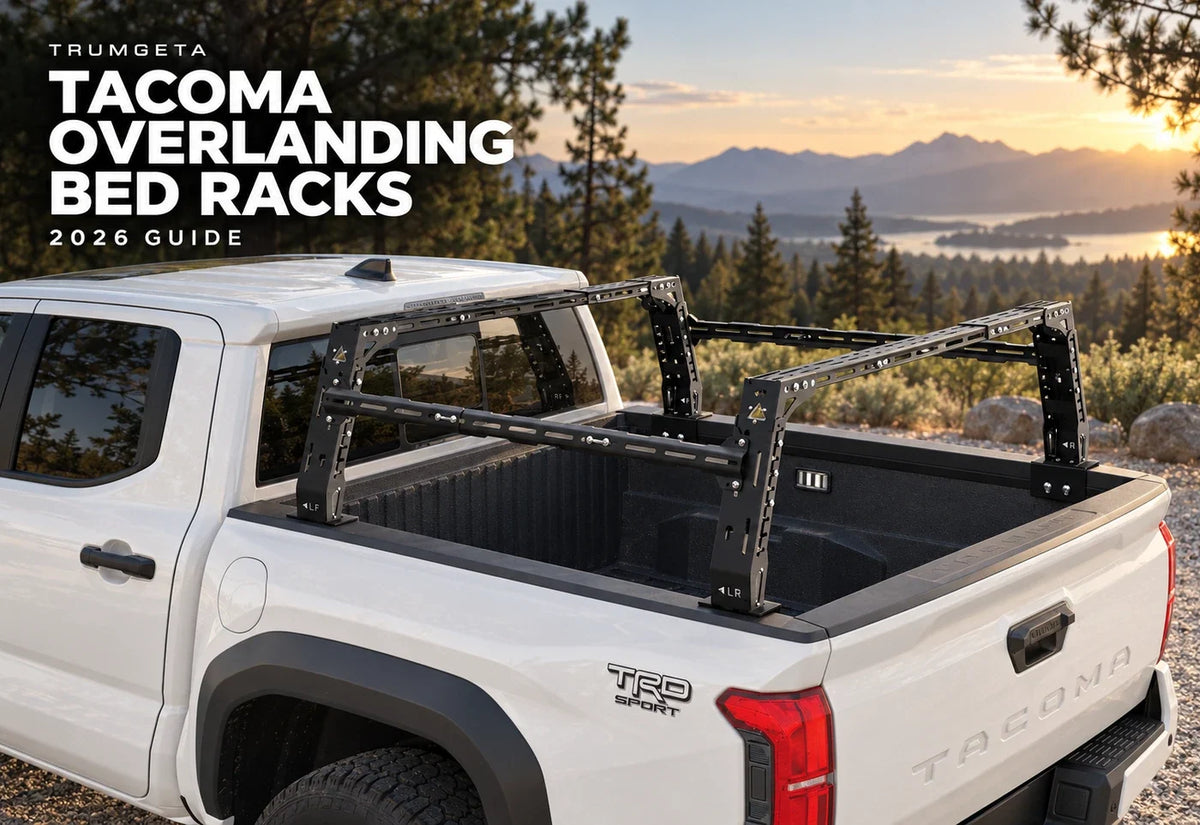
The TRUMGETA adjustable truck bed rack has three height settings and an open frame with slotted members. The selector distinguishes C1902 from C1902V01, with C1902V01 identifying the Tacoma/Gladiator application group for trucks with bed rails. Confirm your year, bed length, and supplied rail hardware before treating that grouping as a fit.
The adjustable height makes this an option to investigate when comparing cab clearance, tent access, and cargo space underneath. However, inspect the actual upper-member shape and mounting surface against the tent brackets. Slots alone do not establish that a clamp can seat correctly or that a tent's mounting rails align with the rack.
The page lists 300 pounds dynamic and 600 pounds static, with a platform excluded from the package. Those figures are not a separate off-road allowance or approval for every occupied tent. The material wording refers to steel or aluminum alloy without clearly resolving it by variant. Request the exact configuration's specifications and tent mounting requirements before ordering.

Yakima OverHaul HD: compare an adjustable crossbar-based arrangement
OverHaul HD offers 19–30 inches of height adjustment. The referenced towers-only listing includes four towers and requires HD Bars, sold separately. A tracked Tacoma bed also needs the appropriate additional mounting kit. Compare the complete application, not just the towers.
Yakima lists base-system maximums of 500 pounds on-road and 300 pounds off-road, subject to application restrictions. Its instructions reduce maximum ratings when the crossbar spread is below 36 inches. A tent that permits closer bars does not remove that rack condition. Do not transfer base ratings to a tonneau-mounted version.
This approach is worth examining when you want to select the support bars and height around the tent. Verify the chosen bars' dimensions, mounting area, and spacing with the tent manufacturer. Include every required kit and bracket in the order.
Leitner ACS FORGED: compare a tent-and-storage layout
The standard Toyota ACS FORGED is 23 inches tall when measured from the bed caps. It combines load bars with a movable bar arrangement and optional GearPOD storage. This can be a useful direction when you want equipment organized around a tent rather than simply carried beneath it.
The Toyota selector separates Tacoma 2005–2023 applications from 2024-and-newer applications, with distinct bed-length selections. Choose the correct version and verify the tent attachment. Do not assume features or fitment transfer to another FORGED family, including a separate tonneau or no-drill product.
Consider what happens after the tent is attached. A bar that can move for bulky cargo may be constrained by the installed tent. Plan tent removal and storage access before relying on that flexibility in everyday use.
Küat IBEX: compare full- and mid-height frame configurations
Küat IBEX offers full- and mid-height configurations with two crossbars. Its parts/application page lists A1 for 2005–2026 Tacoma short beds and C1 for 2006–2026 Tacoma long beds. Verify the complete rack and mounting components for your truck.
The published limits are 300 pounds dynamic and 1,200 pounds static. Its user guide also restricts terrain and use, including rock crawling, jumping, bogging, and high-speed off-road driving. A parked load figure does not override those conditions.
Compare both height configurations on paper before purchasing. Check whether the tent clamps remain accessible, whether the tent opens clear of the cab, and whether your cargo can still be reached. An appealing frame layout only helps if the complete setup works around your equipment.
Considering TRUMGETA ULTRA instead? The ULTRA C1998V01 is a separate factory-inner-rail design. Its current headline, technical table, and description contain conflicting load categories and numbers. Obtain a consistent specification for the exact installation before using it to justify a rooftop tent setup; this comparison does not assign it a definitive capacity.
Complete this fit worksheet before ordering
Gather the information below for both manufacturers. A photograph of your truck is useful, but a written list of dimensions and part numbers is easier to check against an installation drawing.
| Record | Details to collect | Question it answers |
|---|---|---|
| Truck application | Year, bed length, factory tracks, rail photos | Which rack and mounting kit fit? |
| Tent identity | Exact model, generation, bracket version | Which installation requirements apply? |
| Support members | Width, height, shape, usable mounting surface | Can the tent brackets seat correctly? |
| Support spacing | Permitted positions and measured spread | Can rack and tent requirements overlap? |
| Tent movement | Packed outline, open footprint, ladder position | Will the tent open and remain accessible? |
| Load states | Travel equipment and parked occupants | Are all applicable limits satisfied? |
| Other equipment | Exact cover, awning, storage, adapters | Does anything interfere or change the rating? |
If a dimension is missing, ask for it before buying. Do not substitute overall rack length for crossbar spacing, or the bed's advertised length for the distance between tent brackets. Those measurements describe different parts of the installation.
Check crossbar spacing and bracket fit separately
Find a spacing both products permit
The tent needs support at specified locations, and the rack may restrict where those supports can sit. Compare the permitted ranges using the measurement method shown in each manual. Do not assume a minimum spacing is the complete requirement; maximum spacing, rail engagement, and overhang can matter too.
For a concrete example, iKamper's current Skycamp 3.0 Mini guide lists a 22–39-inch crossbar range. That is a requirement for that tent model, not a universal Tacoma rack dimension. It also does not independently approve any rack in this article.
Compare that kind of tent requirement with the rack's own installation limits. For example, the OverHaul HD instructions include a rating reduction below a 36-inch spread. Check the complete instructions for the proposed arrangement rather than assuming every spacing accepted by the tent preserves the rack's maximum rating.
Inspect the bracket's actual contact surfaces
Check bar width, height, profile, and space beneath the bar. A bracket needs more than enough bolt length: it must engage the intended surfaces, clear nearby joints, and be tightened with the specified hardware. Avoid treating slotted plate, square tube, and aerodynamic crossbars as interchangeable shapes.
Confirm the bracket generation supplied with the tent. Current iKamper support pages reviewed for this guide disagree on the height envelope for included brackets: a general hardware page states 1.2 inches, while newer Skycamp information describes 1.5 inches for certain 3.0 brackets. Resolve the exact tent and bracket version with the manufacturer; do not choose the more generous figure by default.
A useful fit question: “Can these exact tent brackets attach to this rack's specified support members at this measured spacing, with the required clearance and load allowance?” Send product links, part numbers, and photographs with that question.
Choose rack height around the packed tent and its opening movement
A lower rack can reduce the packed setup's overall height, but it may place the tent close to the cab or make bed access awkward. A taller rack may improve access below the support bars while raising the tent above them. Choose the lowest approved configuration that provides the clearances your equipment needs.
Measure from the ground to the installed support surface, then account for the actual mounting hardware and packed tent. Do not add a rack's catalog height to a generic truck height: the reference points may differ, and your tires, suspension, and equipment can affect the result. Record the completed vehicle's real overall height for clearance planning.
Next, check the tent open. Some designs extend beyond the packed outline, and the ladder needs an appropriate landing area. Use the tent's dimensions to map the opening side, rear access, awning movement, and tailgate position. Check the space needed to release latches and attach any poles without reaching across inaccessible hardware.
A tent above the bed should not rely on contact with the cab to support it. If the layout extends toward the cab, verify clearance and permitted overhang with the relevant instructions. Do not bridge the cab and bed with an improvised support simply to make a long tent fit.
Finally, check the everyday routine. Can you load a cooler without removing the tent? Can you inspect the front rack feet? Can the bed cover open far enough to be useful? These questions often decide which height is practical after the first camping trip.
Check the travel load and occupied camping load
Use separate lists for driving and sleeping. The driving list includes the packed tent, brackets, permitted stored bedding, awning, accessory mounts, and everything else carried by the rack. The parked list adds occupants and other items used inside the tent. Compare each state with the applicable rack, tent, mounting hardware, and vehicle requirements.
Do not convert a dynamic rating into a static rating using a generic multiplier. Do not use a tent's occupied capacity as proof that the rack can support it. If the tent instructions assign a structural role to the ladder, follow the specified setup; that does not establish the same behavior for another tent.
Vehicle payload and axle limits remain separate checks. Include the rack itself, passengers, supplies, water, and other installed equipment in the truck's load accounting. Follow the component manufacturer's instructions about what its quoted allowance includes instead of borrowing a counting rule from another brand.
Also match the rating to the roads you plan to drive. A static capacity is not an off-road driving allowance. Read the rack's restrictions even when the packed tent is below its listed dynamic maximum. For example, the IBEX user guide excludes technical uses and terrain requiring aftermarket four-wheel-drive suspension upgrades.
Plan the installation before lifting the tent
1. Assemble and verify the empty rack
Install the correct rack and Tacoma mounting kit using the manufacturer's sequence. Confirm the feet, track engagement, clearances, and required fasteners while every attachment is visible. Check that the frame is square and set the support positions to the proposed tent layout before final tightening where the instructions require adjustment.
Use the specified torque for each connection. A single generic torque value is not suitable for every bolt in a rack-and-tent installation. Use thread treatment only where the instructions call for it, and do not modify hardware or drill new attachment points to bypass a fit problem.
2. Lay out the tent mounting hardware
Identify the tent rails, brackets, fasteners, locks, and any approved adapters before the tent is overhead. Confirm that each component belongs to the tent generation being installed. Check access for the required tools; a bracket hidden directly over a frame joint may be difficult to tighten or inspect.
Arrange suitable help or lifting equipment according to the manufacturers' directions. Choose a level work area with room around the truck. The rack should be ready to accept the tent before lifting begins, rather than becoming an elevated workbench for solving an uncertain bracket arrangement.
3. Position and secure the tent as instructed
Place the tent within the approved support positions and overhang limits. Verify the opening orientation before fastening it. Follow the prescribed bracket engagement and tightening sequence, then check that the tent, mounting rails, and rack members have the intended contact and clearance.
Do not add spacers, longer bolts, a platform, or alternative clamps simply because the supplied parts are awkward to reach. Such changes need manufacturer approval for the complete arrangement. A platform is another component to verify, not an automatic cure for incompatible bars.
4. Rehearse the complete camp setup at home
Open the tent on suitable ground, position the ladder as directed, and operate the cover, tailgate, awning, and storage compartments. Check that you can enter the tent, reach essential equipment, and pack everything away without loosening structural connections. Keep tools and loose items clear of the tent's moving parts.
After a short local drive within the permitted use, inspect according to the manufacturers' directions. Recheck equipment security before trips and follow the specified maintenance guidance. A successful driveway rehearsal can expose practical problems; it does not replace an approved installation or certify a custom combination.
Compare the cost of a complete usable setup
Request an itemized list covering the rack, Tacoma mounting kit, crossbars, tent brackets, approved adapters, and any cover-specific hardware. Include installation and shipping when comparing the total. A towers-only listing should be completed with its required bars and kits before being compared with a frame package.
Think about removal too. If the Tacoma is also your work truck, decide how the tent will be lifted off and stored. Confirm which rack components can remain installed and which fasteners must be rechecked when the tent returns. Ease of removal is part of a useful setup, not just an installation-day concern.
Start your comparison with TRUMGETA bed rack options. Send your exact truck, tent, bracket, cover, and intended-road details through the TRUMGETA contact page for application confirmation. Choose the rack whose documented mounting arrangement and practical layout both work for your tent.
Frequently asked questions
What is the best Tacoma bed rack for a rooftop tent setup?
The best choice depends on the exact Tacoma, tent, mounting hardware, and intended roads. Compare TRUMGETA C1902V01 for adjustable frame height, Yakima for adjustable towers, Leitner for storage organization, and IBEX for a configurable frame. Confirm the complete tent installation before treating any option as suitable.
Will any rooftop tent fit a Tacoma bed rack?
No. Check the tent's support spacing, mounting-rail positions, bracket dimensions, load requirements, and permitted overhang. A rack can fit the truck while remaining incompatible with a particular tent's hardware. Broad rooftop-tent language in a listing does not replace those checks.
How far apart should the crossbars be?
Use the range permitted by the exact tent together with the rack's installation requirements. Confirm how the manuals measure that distance. A tent's minimum spacing alone does not establish the right position or preserve the rack's maximum rating; maximum spacing and support engagement may also matter.
Should the rooftop tent sit below or above the Tacoma cab?
Either arrangement requires model-specific clearance checks. Compare the packed tent, its opening movement, permitted overhang, ladder position, and bed access. Choose an approved height that works for the full layout, and measure the completed truck rather than assuming the cab roof is the correct reference.
Does the rack's static rating include people sleeping in the tent?
Follow the manufacturer's definition and occupied-use requirements for the complete installation. Do not assume a listed static number approves every tent, occupant load, or support arrangement. The tent, rack, mounts, and vehicle must all meet the conditions relevant to the parked setup.
Can I keep a tonneau cover with the tent rack?
Only where the exact rack, cover, and mounting hardware form a supported combination. Check the cover's opening path, channel interface, and any application-specific load changes. Factory bed tracks and cover accessory channels are different interfaces, even if both are described as T-slots.
Do I need a platform between the rack and tent?
Use one only when the tent and rack manufacturers approve or require it for the arrangement. A platform adds weight, height, and another mounting interface. It does not automatically solve bracket or support-spacing problems. The TRUMGETA C1902 listing specifically excludes a platform from the package.
What should I send when asking TRUMGETA to confirm fit?
Send the Tacoma year and bed length, bed-rail photographs, exact rack SKU, tent model and generation, bracket version, cover model, equipment weights, and intended roads. Include the tent's mounting diagram and any uncertain measurements so the proposed complete installation can be evaluated.

Leave a comment
This site is protected by hCaptcha and the hCaptcha Privacy Policy and Terms of Service apply.